MISSION — The Wildhorse Foundation celebrates 25 years of giving back and supporting programs that strengthen the Confederated Tribes of the Umatilla Indian Reservation (CTUIR) and neighboring communities.
The Wildhorse Foundation, a community fund managed by the CTUIR in partnership with Wildhorse Resort & Casino (WRC), has now reached a significant milestone of 25 years of giving back to the surrounding communities.
According to the foundation’s press release, more than $20 million in grants have been awarded to support education, public health and safety, gambling addiction prevention, the arts, the environment, cultural programs, salmon restoration and historic preservation. In recent years, the organization has distributed more than $1.5 million annually through over 100 grants.
Among the recipients in the most recent quarterly cycle are Crow’s Shadow Institute of the Arts ($30,000), Nixya’awii Community School ($20,346), Neighbor 2 Neighbor Pendleton ($25,000) and the Salvation Army Pendleton Corps ($25,000).
Neighbor 2 Neighbor Executive Director Dwight Johnson said the Wildhorse Foundation has been critical to the organization’s survival.
“Without the Wildhorse Foundation, we wouldn’t be operating,” Johnson said. “They’ve supported us in a variety of ways, but most importantly through a significant portion of our operating funding.”
Johnson said the organization’s expenses increased after COVID-19 reduced its volunteer pool, forcing it to hire nighttime staff.
“That significantly raised our costs, and the Wildhorse Foundation became our primary supporter,” he said. “We’ve had help from others, including the Blue Mountain Community Foundation and, most recently, Amazon Web Services, but Wildhorse has been the foundation for us.”
In addition to operating support, Johnson said the Wildhorse Foundation helped fund major facility needs, including replacing a broken furnace.
“They covered more than half the cost, which was significant,” he said. “We’re very appreciative of everything they do.”
Pendleton Public Library Director Jennifer Johnson said she spoke with a Wildhorse Foundation representative at a funder’s forum several years ago and was struck by the foundation’s focus on supporting new ideas rather than providing recurring funding for the same projects.
“I walked away knowing I needed to create a sustainability plan for each project we asked the foundation to fund,” she said. “They want to see that you’ve taken that seed money and figured out how to make your project work long term.”
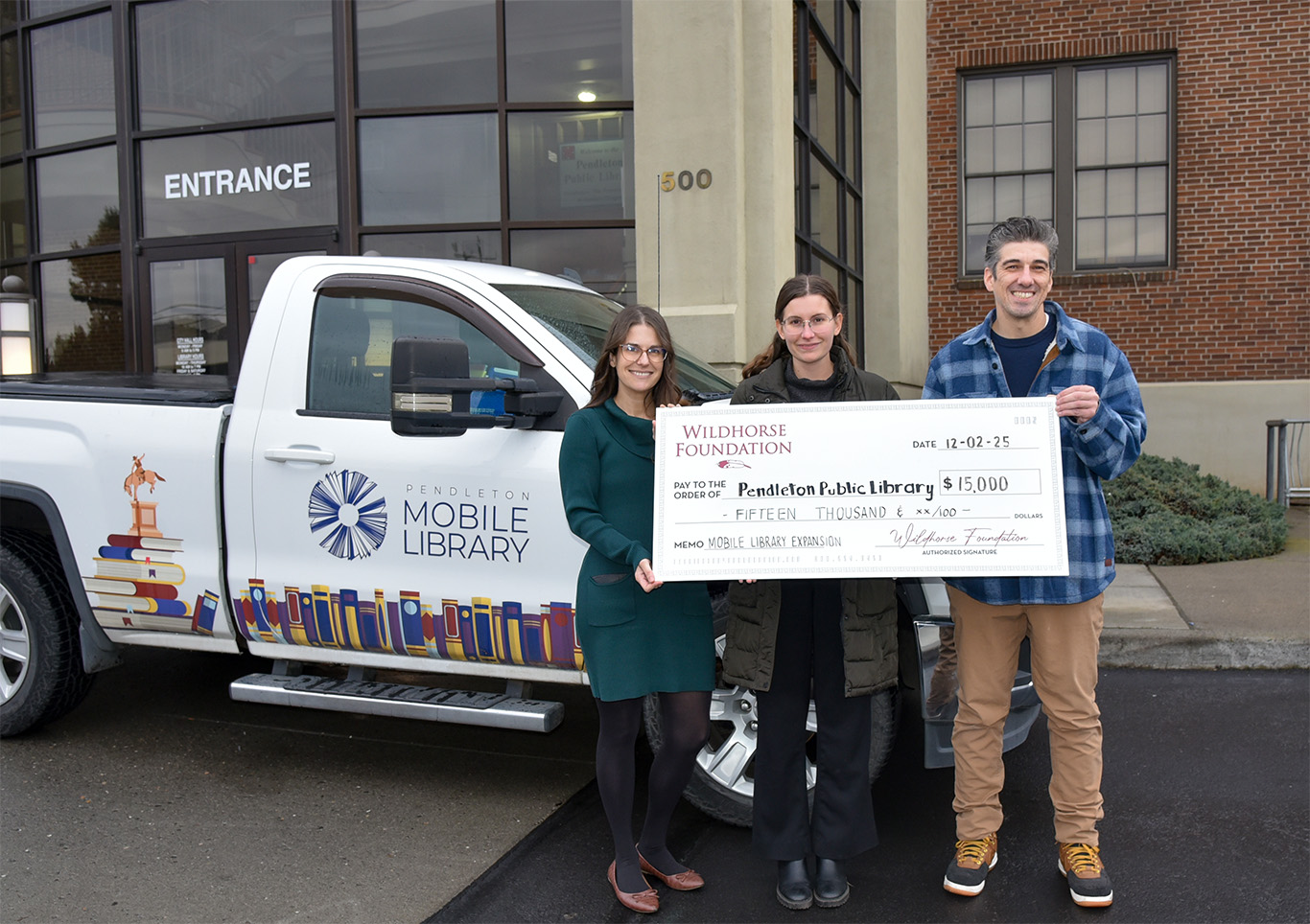
Johnson said the Wildhorse Foundation has supported the library in a variety of ways over the years, from story time incentives and technology upgrades to capital funding for an ADA-accessible mobile library campaign.
With the foundation’s support, the library has expanded story times, upgraded technology and recently launched a fundraising campaign for an ADA-accessible mobile library, she said.
These projects reflect the foundation’s focus on supporting strong initiatives that continue to benefit communities beyond the initial grant.
Built on tradition, expanded through gaming
The foundation became operational in January 2001, as part of the amended Tribal-State Compact between the CTUIR and the State of Oregon. The amendment determined that with the introduction of New Class III gaming at Wildhorse Resort & Casino, a percentage of gaming revenues generated would be contributed to a community benefit fund.
Ella Meyers, administrator for the Wildhorse Foundation, said the organization provides a valuable funding option for many institutions in the region. She said it offers quarterly grant cycles, a simple application process and supports a wide range of projects across a broad area.
“People feel that impact, and they see it everywhere they go, through the services they depend on, the opportunities available for their children,” Meyers said. “Many of these funds are used to reduce barriers to accessing the resources that allow all in the region to thrive.”
In 2000, the Board of Trustees (BOT) of the CTUIR formally approved the establishment of the Wildhorse Foundation, the Wildhorse Fund and its Bylaws. The grants were to be expended for the benefit of the public within Umatilla, Union, Morrow and Wallowa counties. This included charitable organizations, the CTUIR, and local government bodies.
In 2009, an amendment to the Compact expanded the Foundation’s footprint by changing the list of grant-eligible recipients. The new definition also included the Tribes’ ceded territory in Washington State, which is most of Benton, Columbia, and Walla Walla counties, as well as any Native American tribal government agency or Native American charitable organization with its principal office and base of operations within the State of Oregon, and any national or regional Indian organization.
“Often, organizations approach the Foundation for a relatively small contribution on a much larger project, but then leverage that grant when they approach larger foundations and pursue state grants. Showing that initial contribution from a regional foundation can really make a difference,” said Meyers.
In 2023, the Foundation amended its bylaws, raising the annual cap on fund awards per recipient to $30,000 from $20,000. This decision was made in response to inflation and the resulting increases in project costs.
“Over time, the Foundation has become an important resource for nonprofits in our area, and often for smaller organizations that are largely volunteer-run and have limited capacity. It’s certainly left a big mark in 25 years, staying approachable but with a large regional footprint. Some of these funding relationships span decades, like Oregon East Symphony, Athena’s Gem Theatre, and Umatilla County Historical Society,” said Meyers.
This grantmaking reflects the CTUIR’s traditional values of giving back and stewarding the homeland communities of the Cayuse, Umatilla, and Walla Walla people. Although gaming helped establish the Foundation, it builds on a longstanding tradition of generosity and stewardship.