MISSION — A new agreement between the Confederated Tribes of the Umatilla Indian Reservation (CTUIR) and the U.S. Army Corps of Engineers (ACE) could reshape flood control and fish restoration efforts on the Walla Walla River.
The CTUIR Board of Trustees (BOT) approved Resolution 26-007 on Feb. 23 at the Nixyáawii Governance Center, authorizing the agreement and advancing a memorandum of understanding (MOU) for the Nursery Bridge General Investigation Study.
Before the vote, trustees met Feb. 11 in a work session with Anton Chiono, habitat conservation project leader for the CTUIR’s Department of Natural Resources (DNR), to review the proposal.
“Part of this work involves navigating an ACE-certified flood control project, which requires a lengthy process,” Chiono said. “We’re just at the beginning, exploring alternatives to improve fish passage and habitat in that reach.”
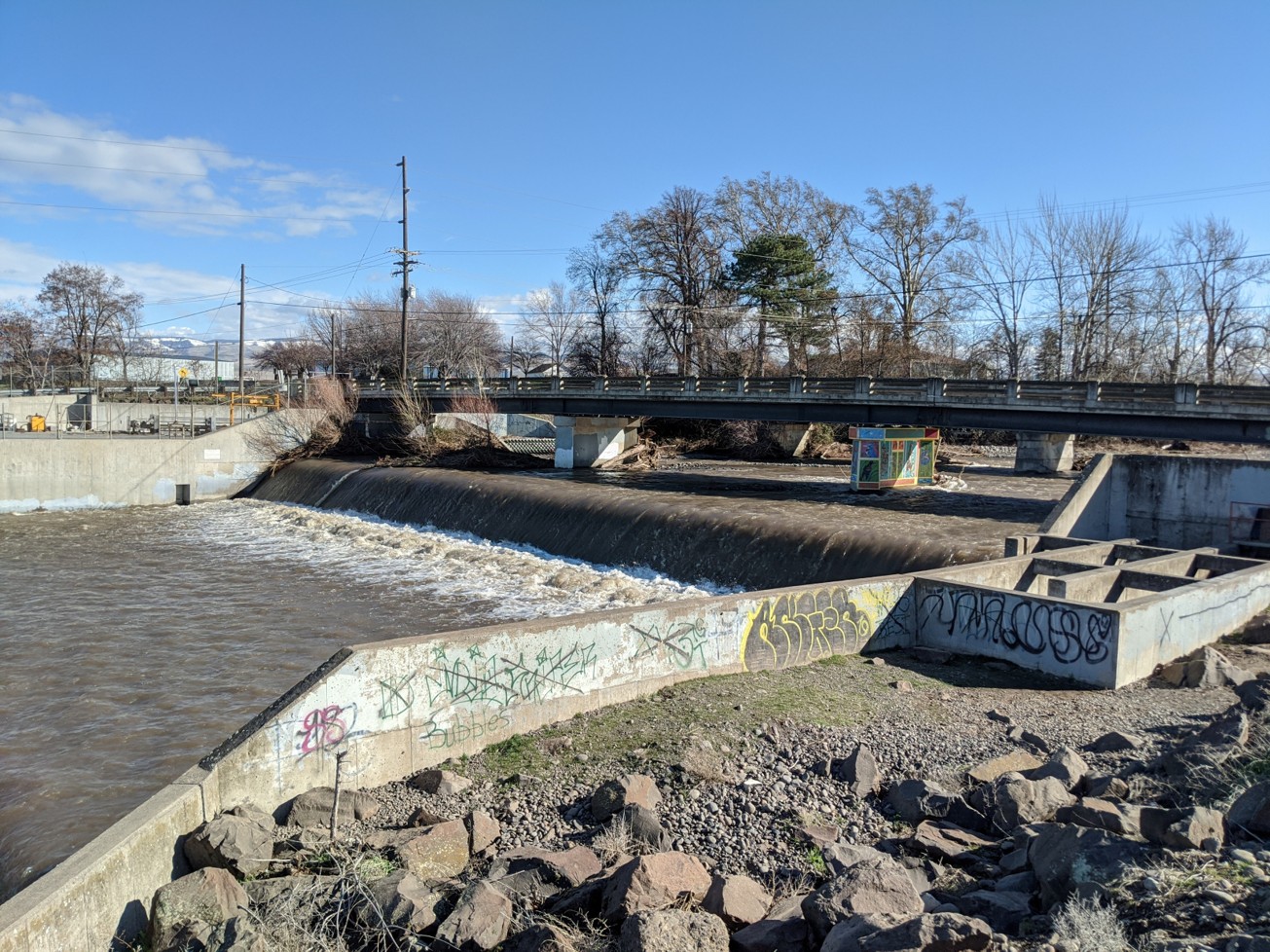
Along the Walla Walla River in Milton-Freewater, the Nursery Bridge Reach Flood Control Project dates to the 1940s, when the ACE built levees and a drop control structure. Over time, levee raises intended to prevent flooding increased water velocity and accelerated erosion, which the drop structure was meant to slow.
“When a river is straightened and constricted between levees, its velocity and erosive power increase,” Chiono said. “Installing a drop structure is how the Corps tried to address this, but it’s really just a Band-Aid. Now the river is eroding around the structure itself.”
Reconnecting the Walla Walla River habitat
While the structure stabilizes the channel, it blocks fish from migrating upstream, making it harder for summer steelhead and spring Chinook to spawn.
Under federal policy, the ACE can modify flood control projects, and CTUIR is working with the agency to add ecosystem restoration at Nursery Bridge. The study will also look at ways to improve fish passage and restore habitat.
As part of the plan, CTUIR will share costs with the ACE 50-50 for the study’s design phase, which could take up to three years and cost no more than $6 million. The tribe could be responsible for up to $3 million.
CTUIR will also lead communications and public outreach, coordinate with state and federal agencies, provide fisheries expertise, update stakeholders and plant riparian vegetation where it won’t affect levee safety.
Resolution 26-007 notes that the CTUIR is working with Oregon, Washington and local stakeholders to implement the Walla Walla Water 2050 Plan, which aims to restore fish passage and improve habitat. Strategy 1.09 specifically calls for protecting and enhancing fish passage in the nursery reach and implementing levee setback projects upstream and downstream of Milton-Freewater.
Chiono said next steps include finalizing the MOU, negotiating the cost-share agreement in early 2026, developing the study’s scope, schedule and budget and holding public outreach meetings.
From 2026 to 2028, the tribe and ACE will use the study’s findings to evaluate and develop a list of alternatives.
Chiono emphasized the CTUIR’s goal of securing broader ecosystem restoration authority for the Walla Walla River through the upcoming Water Resources Development Act. While the ACE already has aquatic restoration authority in the basin, the tribe is requesting Section 536 authority, like that for the Columbia River Estuary, which would let Oregon and Washington work closely with the ACEand affected tribes on restoration projects.
He added that the authority isn’t required to advance the Nursery Bridge study but would provide long-term benefits for the river’s overall health beyond fish passage.