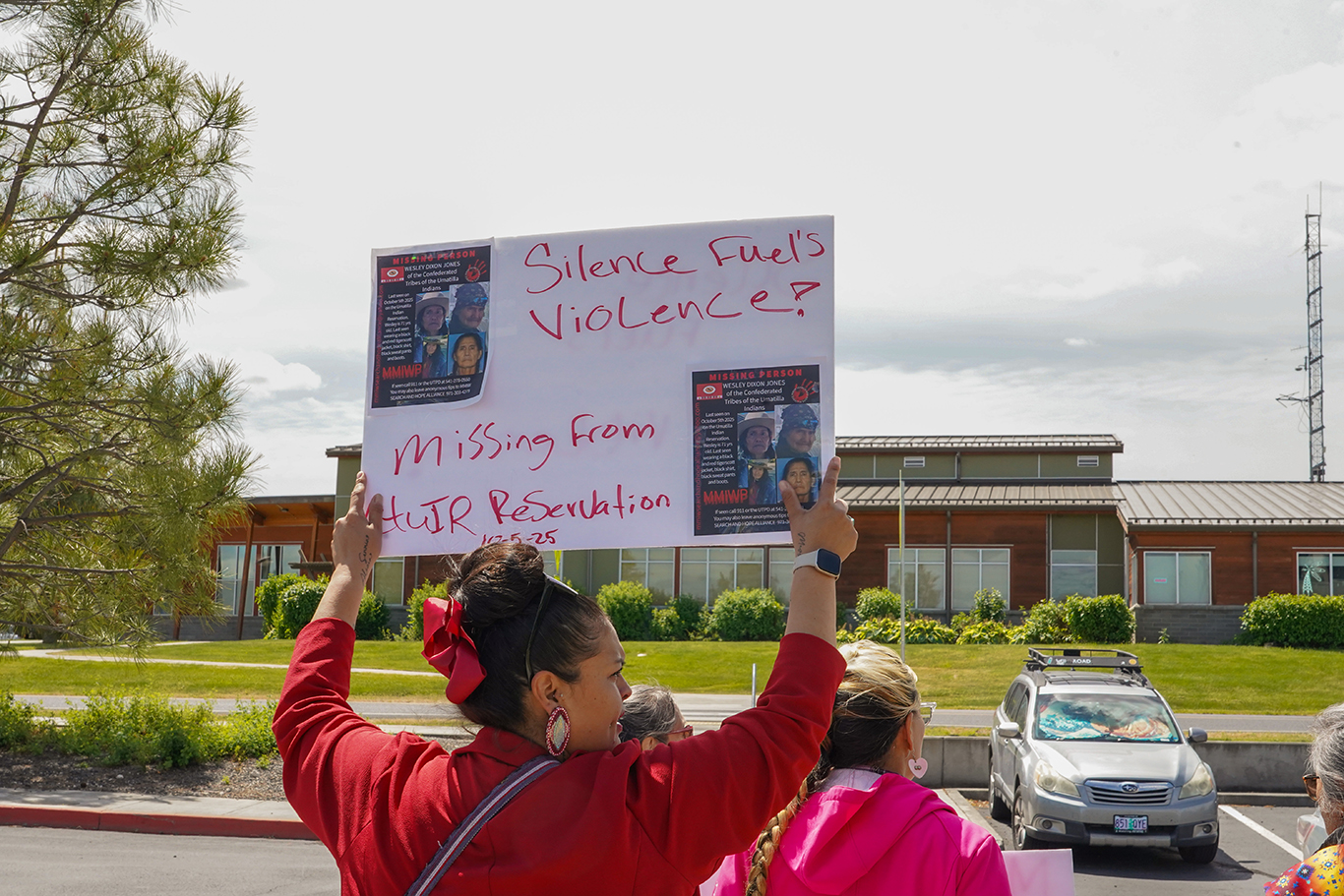
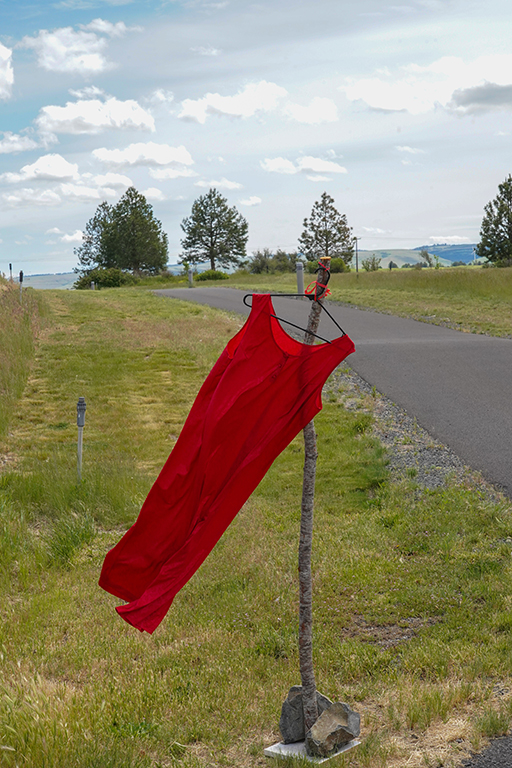
MISSION — Members of the Confederated Tribes of the Umatilla Indian Reservation (CTUIR) gathered to recognize the month of May as Missing and Murdered Indigenous Peoples’ Month (MMIP).
On May 14, CTUIR Family Violence Services (FVS) hosted a walk and lunch at the Nixyáawii Governance Center to recognize, support and honor the families of missing and murdered Indigenous relations.
Guest speaker Chico Holliday, of the Confederated Tribes of Warm Springs, shared remarks focusing on raising awareness and supporting families and communities affected by violence and loss.
According to the Bureau of Indian Affairs (BIA[1] ), about 1,500 American Indian and Alaska Native missing person cases have been entered into the National Crime Information Center throughout the U.S. The agency also reported about 2,700 murder and non-negligent homicide cases to the federal government’s Uniform Crime Reporting Program.
Combined, the figures represent approximately 4,200 missing or murdered cases that remain unsolved.
The BIA attributes the unsolved status of these cases to a lack of investigative resources available to identify new information from witness testimony, re-examine new or retained material evidence and rewire fresh activities of suspects.
Holliday spoke to the crowd about when his daughter went missing and the efforts it took to find her.
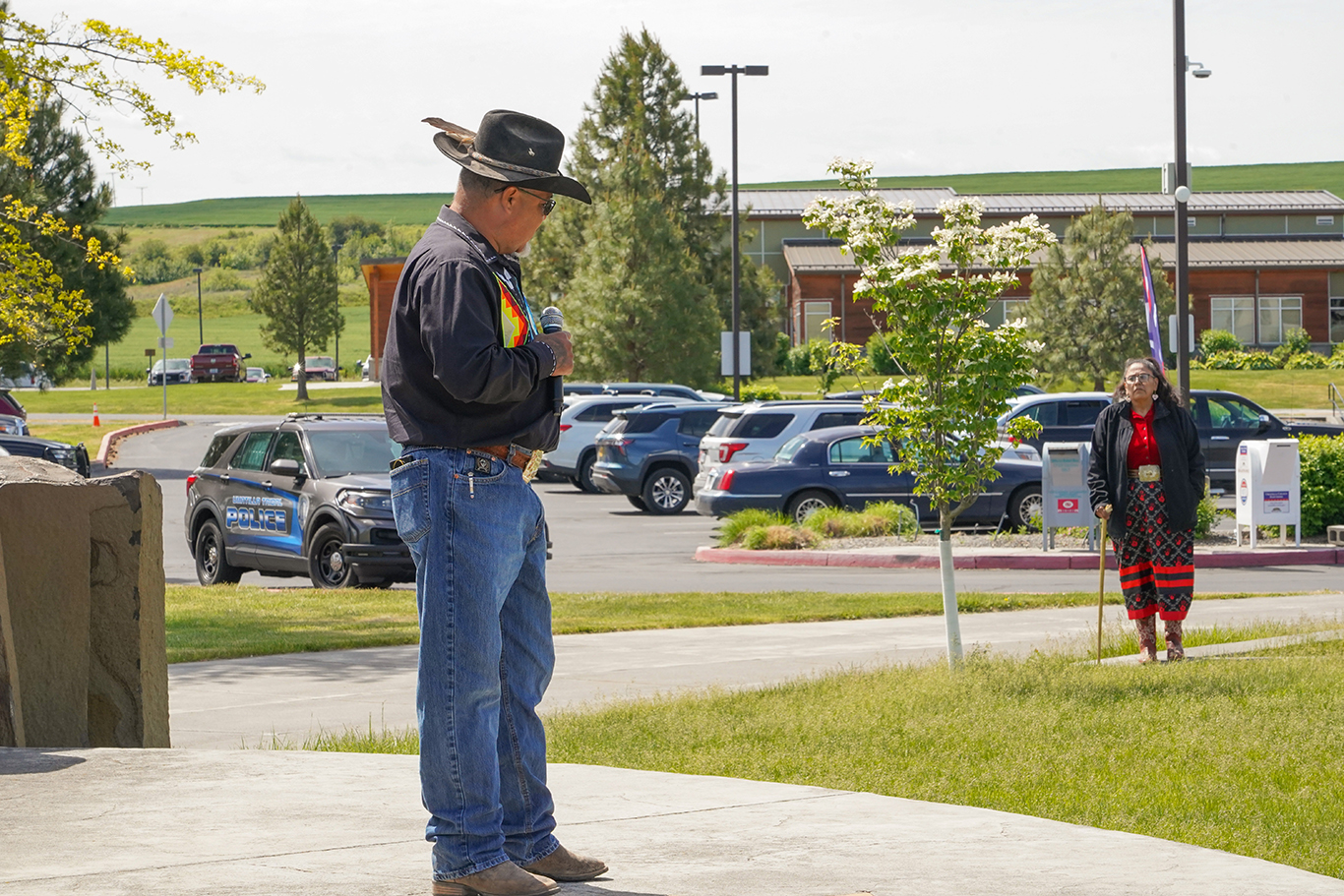
“It doesn’t only affect the families, but also the community as a whole because every community that we live in is really small,” he said. “Everybody knows everybody, and it’s really difficult to watch those families go through it.”
Holliday described the challenges he faced in locating his child, including local law enforcement initially classifying her as a runaway and the jurisdictional boundaries that hindered the investigation.
“I went to our tribal police and filled out a runaway report because that was the first step I was told to take,” Holliday said. “And then from the moment she crossed that line, that imaginary jurisdictional line, it became the county’s problem, and when she went further than that and went into the city, that became a city problem.”
There were roughly four county boundaries that were navigated, he said.
“There was nothing they could do until it escalated to the point where there was potential trafficking,” Holliday said. “At the time, I wasn’t sure, but then we started getting these weird phone calls and that’s when it escalated.”
In a 2017 Government Accountability Office report titled “Human Trafficking: Investigations in Indian Country or Involving Native Americans and Actions Need to Better Report on Victims Served,” tribal and major city law enforcement agencies were surveyed on human trafficking investigations, victim services and barriers to identifying and serving Native victims.
In the survey, 27 of 132 tribal law enforcement agencies and six of 61 major city law enforcement agencies reported initiating human trafficking investigations that involved at least one Native American victim, accounting for 17% of the agencies surveyed.
The report noted 16 respondents identified several barriers to investigating cases and supporting victims, including a lack of training on identifying and responding appropriately to victims, victim shame and reluctance to come forward and the limited resources.
Holliday said once he shared the strange phone calls with a deputy assistant, the case escalated to the point where a national alert went out. He said he was able to retrieve his daughter within seven hours of the alert.
“That trauma did not just affect our daughter at that time; it affected the whole household,” Holliday said.
FVS Lead Advocate Enola Dick said a big challenge is how long it takes for law enforcement to determine whether a victim is missing or has simply run away, especially in the cases of younger people.
“That’s part of their excuse to do nothing,” she said. “That’s kind of the thing everywhere, it’s, ‘Oh, everybody’s either out partying, drinking or they ran away and they’ll be home,’ so they put it off way too long before they start looking. Sometimes, by then, they’re never going to find them.”
Dick said another barrier, similar to Holliday’s experience, is jurisdictional boundaries.
“Our tribe used to go through that, too. If a crime happened close to our borders, they would say, ‘Oh, well we need to measure and make sure it’s on the reservation or not.’ Well, now that we work with the sheriff’s office more, there’s not such a problem,” she said.
In cases of human trafficking, barriers become more complex because trafficking often crosses jurisdictional boundaries or state lines.
“That’s part of what helped (Holliday) get more help, was that there were rumors of trafficking,” Dick said. “So at least they could get national attention, and they got more help than he was getting because of all of the boundaries that they were going through.”
Dick said social media could simultaneously serve as a hindrance and an asset in cases such as these. In Holliday’s case, he was able to access his daughter’s Instagram account and learn where she was. But there is also the negative aspect of anonymous predators.
“Young people, there are so many different social media accounts to be on, and a lot of these sites are not good, they’re not healthy,” Dick said. “They’re sites where there are perpetrators preying on young people, girls and boys. Sending fake pictures that aren’t them, sending explicit photos of themselves – or so they say – and then wanting them to send something in return.”
Holliday said the best one can do is to pray alongside those who are going through the challenge of having a missing or murdered relative.
“Pray for them with the understanding that somehow, some way, we’re going to be able to assist them,” Holliday said. “My message today is don’t give up. Don’t stop. I had to literally go out there and knock on doors trying to find information, trying to locate her while my wife was on the other end going through media accounts.”
A list of open missing or murdered Indigenous Persons cases can be found at https://www.bia.gove/service/mmu/missing-murdered-cases. To submit information or a tip, text BIAMMU and Your Tip to 847411, call in to 1-833-560-2065 or email OJS_MMU@bia.gov.