MISSION — A homeowner cited for illegally dumping construction and personal debris into upper South Coyote Creek on trust land, violating tribal regulations, said he is working with the Confederated Tribes of the Umatilla Indian Reservation (CTUIR) to restore the damaged site.
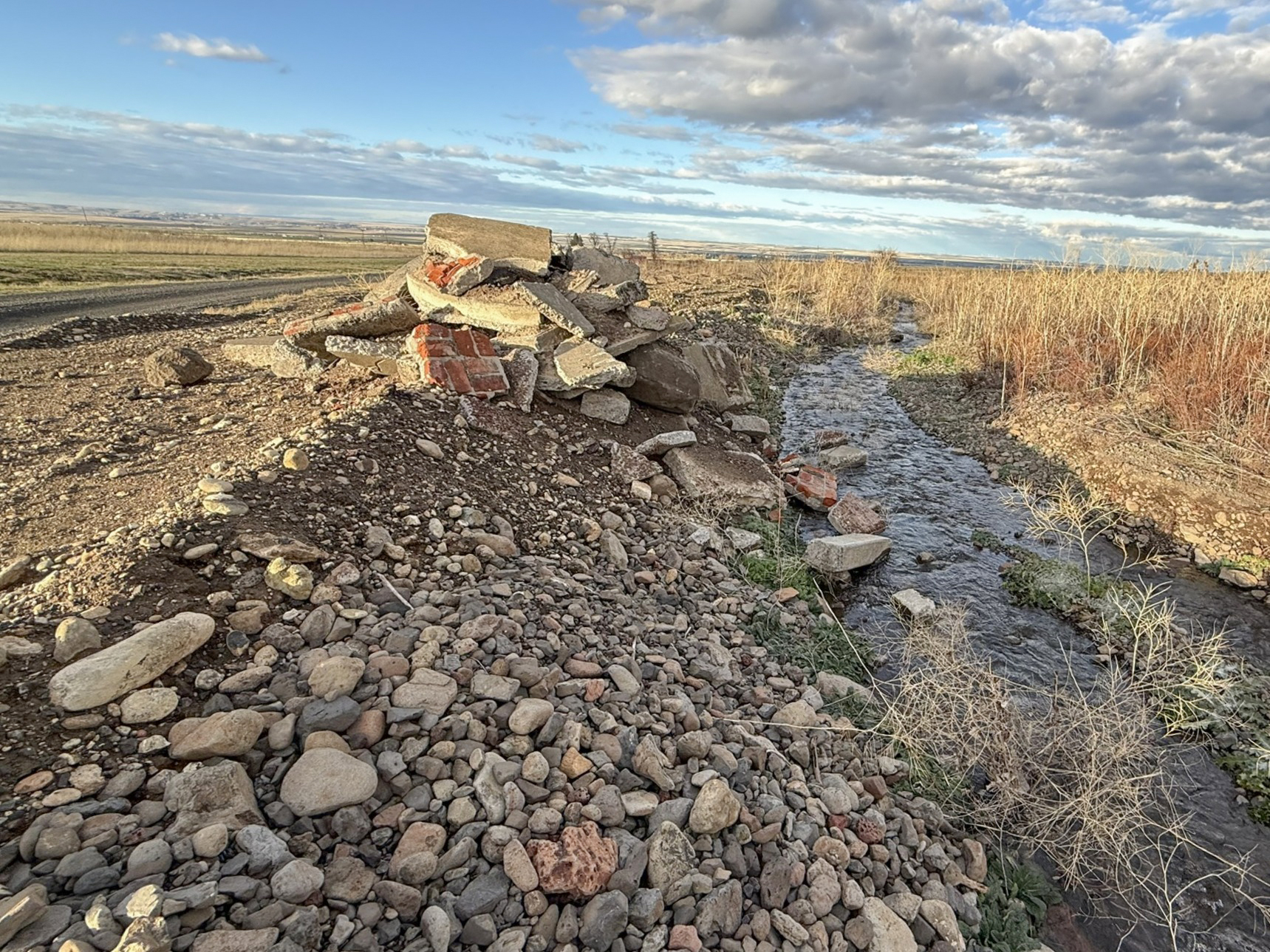
CTUIR officials issued a warning notice on Oct. 21, 2025, after determining that the homeowner, George Diggins, had transported materials from the Wildhorse Resort & Casino (WRC) construction site across his property and deposited them on trust land near the end of South Market Road.
Diggins, 77, who has lived on the Umatilla Indian Reservation for 52 years and lives on fee land east of the creek, said he has begun removing material and consulting with engineers to develop a restoration plan for trust land west of the stream.
Diggin said he has hired someone to help with the cleanup and will provide updates to the CTUIR planning department.
The warning notice cited violations of tribal land development, environmental health and safety, water, and historic preservation codes. Brian Fullen, an environmental health and safety specialist for CTUIR, said debris — including asphalt, cinder blocks, bricks, crushed PVC plastic, and soil — covered roughly three-quarters of a mile of creek and floodplain.
“This unpermitted land use is in violation of CTUIR law, must stop immediately and requires immediate remedial action,” the notice stated. “If the violation is not corrected within 30 days, or steps toward correction are not being followed, citations will be issued.”
To confirm property lines, Tribal officials surveyed the area to confirm property boundaries along an easement road. Diggins lives on fee land east of the stream, while the affected trust land lies to the west.
Under the Bureau of Indian Affairs, fee land is privately owned and subject to state and local law. In contrast, trust land is held by the federal government for tribal use and governed by tribal and federal regulations.
Diggins recalled that at the time he agreed to store the equipment and materials because he owns a dump truck and a pup trailer and had space available. He said that he first planned to place the items on the other side of his property, but changed course after noting that water flows in that direction and a creek had washed out much of the fence line.
“I’m the one who said I got a place for it. It was not their fault,” Diggins said. “We all thought everything was fine. I never dreamed it would develop into this situation.”
Although he did not name any contractor working on the WRC construction site, he said multiple subcontractors are working there, but they were not at fault for his decision to dump the debris on South Coyote Creek.
Patty Perry, CTUIR planning director and author of the notice, said Diggins has taken initial steps to comply, prompting the tribe to extend its 30-day deadline.
“He is working on arrangements to get a qualified engineer involved with a restoration plan for removing the material and restoring the stream,” Perry said. “He must submit that plan to us within a certain period of time.”
Diggins said his contractor expects to take two to three days to remove the concrete, followed by clearing the remaining debris. He noted the work will not take long because much of the material is scattered and vegetation has already grown through it.
CTUIR officials are monitoring downstream risks during high-water season. Fullen said previous flood mitigation work could be undone by the dumped debris, potentially affecting homes, septic systems and the Umatilla River.
Perry said the creek is prone to rapid flooding, especially near culverts that can become blocked and send water over roads.
However, Diggins expressed concern that removing all the debris could increase flooding along his road. He said he believed he was protecting his property and preventing flooding.
“Back in my era, people worked to control creeks so they wouldn’t flood nearby land,” he said. “Now it’s supposed to go back to natural.”
He said he did not act with the intent to harm anyone.
Although Diggins is working to clear the debris, Fullen said the dumping has created flood risks and could require a cleanup costing up to $500,000, a cost Diggins would be responsible for covering.
Diggins expressed concern about the potential expense.
“I don’t have that kind of money,” he said. “We’re going to do the best we can.”
He said he sold irrigated ground and equipment to the tribe 18 months to two years ago to pay off loans and federal taxes, leaving him reliant on Social Security and occasional work.
CTUIR officials said they will continue communicating with Diggins about the site and downstream areas during high water. Diggins is required to hire licensed contractors to carry out any removal work and engineers must design a plan to stabilize the creek and protect culverts, septic systems and nearby homes.
If Diggins does not meet the requirements, CTUIR officials said they will take further enforcement action if he fails to meet agreed-upon deadlines.