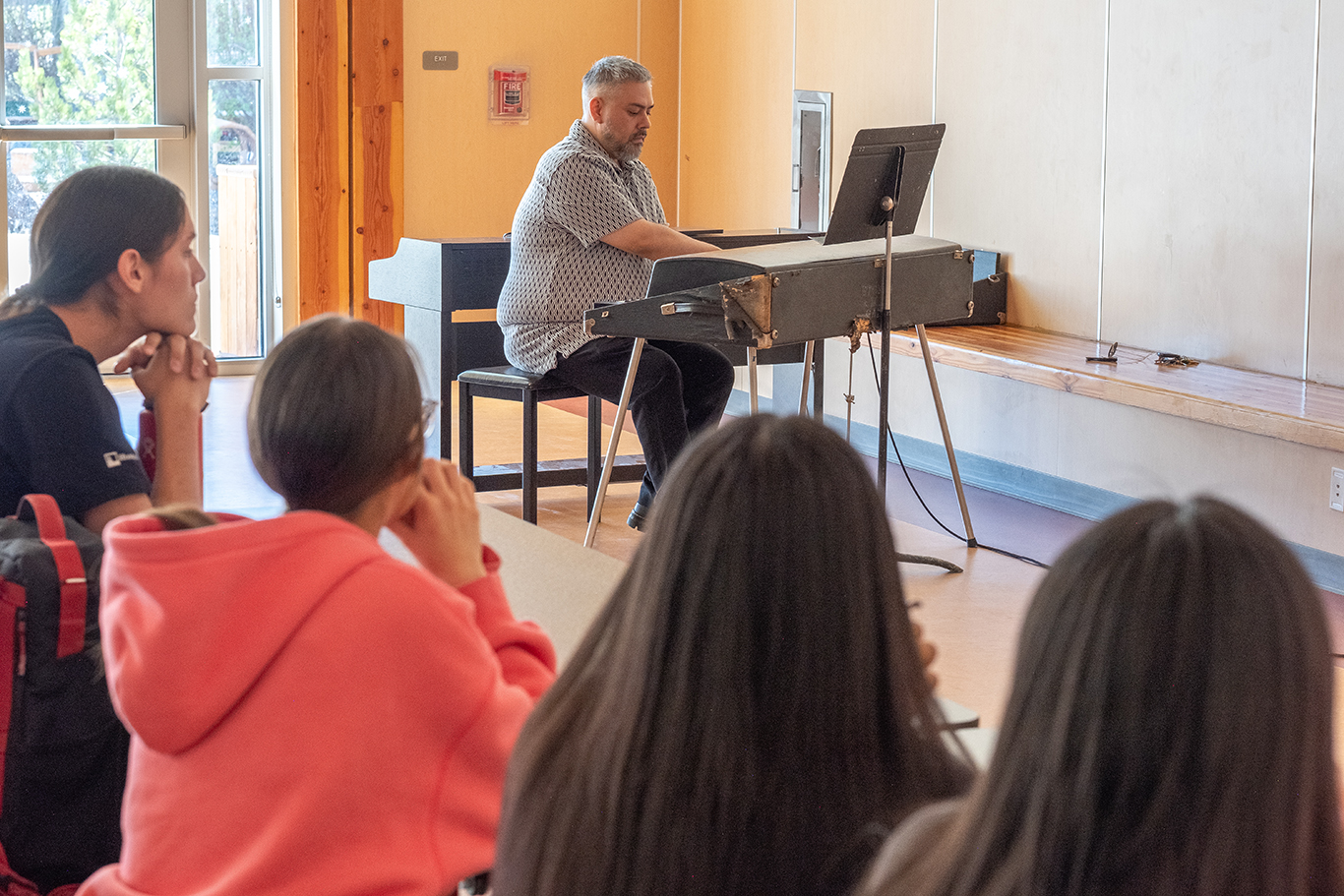
MISSION — Live piano music filled the halls of Nixyáawii Community School (NCS) as Diné composer Connor Chee shared personal work rooted in culture and storytelling with students.
Navajo pianist and composer Chee visited the school on April 9 to perform a selection of his original compositions and to speak about his journey as an Indigenous musician. The visit was one of several stops leading up to his guest concerto performance with the Oregon East Symphony (OES) at the Vert Ballroom on Saturday, April 11.
In addition to his appearance at Nixyáawii, Chee gave presentations at Pendleton High School and worked with local piano students through the Oregon Music Teachers Association.
Chee is known for combining his classical piano training with his Navajo heritage. His resume includes winning the gold medal in the World Piano Competition’s Young Artist Division at age 12 and performing at Carnegie Hall in New York City shortly thereafter. He has a bachelor of music from the Eastman School of Music and a master’s degree from the University of Cincinnati College Conservatory of Music.
Chee was awarded first prize in the 2016 Bradshaw & Buono International Competition, which earned him another performance at Carnegie Hall for the winners’ recital. He has released three studio albums — the most recent being “Scenes from Dinétah” from 2020 — and is currently a voting member of The Recording Academy, also known as the Grammy Awards.
OES Executive Director James Dean Kindle said Chee has given educational presentations about his work before and they had thought it would be a great opportunity for him to do another while he was in the area prior to his concert that weekend.
Chee said he’s encountered a lot of preconceptions from people when they encounter Indigenous music.
“Today, it is so vast because we have Indigenous artists that are certainly doing traditional music, but there’s also what I’m doing, which is a contemporary-classical style,” Chee said. “Even among the composers who do that, it can sound different because we have different approaches. There are also hip-hop artists and pop and all sorts of other genres coming from indigenous artists that are influenced by their background and their heritage. For my music, people have this idea of powwow drums and the Native flute and certainly that’s a part of the culture, but that’s not always what’s to be expected if you’re experiencing music from the community.”
Kindle said it makes for a more holistic experience for the audience, providing more context prior to going into the concert experience.
“At the OES, we always strive to add educational components to all of our concert activities, especially when it comes from the guest artists that come and visit us,” he said. “There’s a diverse array of performers from all backgrounds, from all over the world and that includes a very vibrant scene of indigenous composers and performers.”
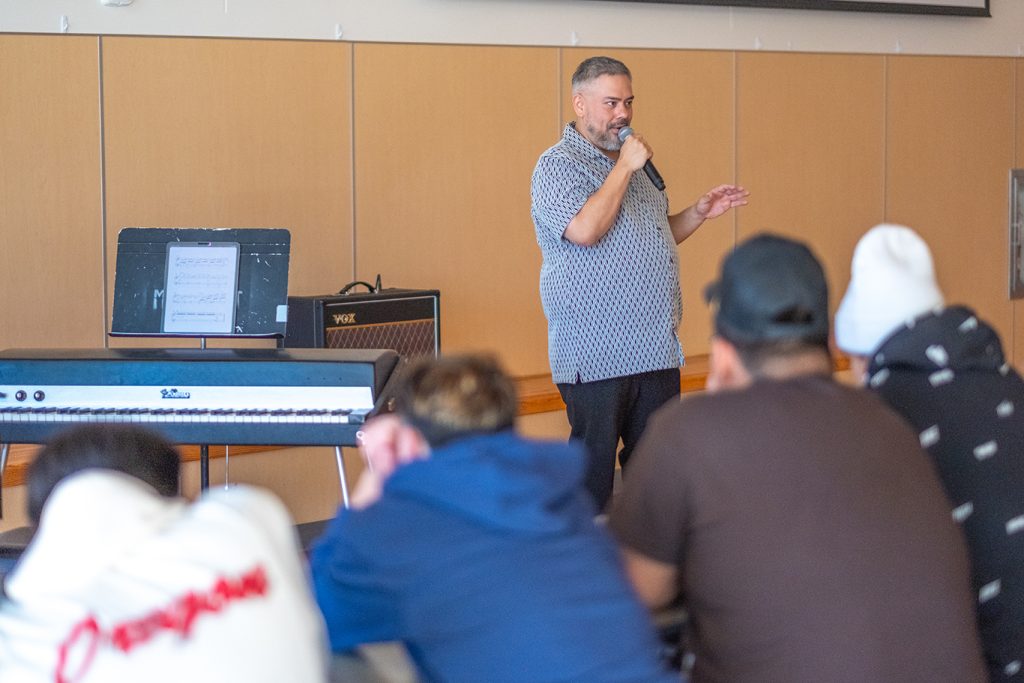
A way to move forward past these perceptions, Chee noted, is by opening a line of communication, for an audience to try to go in with an open mind for what they’ll experience and that they’ll hopefully learn something new.
Starting his career as a performer, Chee initially envisioned himself performing a standard classical repertoire, akin to classic composers Mozart or Beethoven. It wasn’t until he graduated from college and returned home that he began to combine his classical piano training with his upbringing, heritage and culture.
“I was already playing classical music, but as more people took interest in it and as it started to open up conversations about my heritage, I started doing more,” Chee told the students during his presentation.
NCS Principal Ryan Heinrich said the school is always looking for opportunities like this for the students.
“I thought it was great,” Heinrich said. “He’s very talented and a lot of these kids have never had piano lessons; it was great to see.”
Kindle said initiatives like this started back in 2019 when OES collaborated with Diné composer Raven Chacon and Crow’s Shadow Institute of the Arts (CSIA). During Chacon’s three-week residency, while he composed a new chamber of work, a set of lithographic prints was produced at CSIA.
“We really pride ourselves on championing indigenous composers,” Kindle said. “I think it’s diversifying our programming, that it’s relevant to our community and I don’t think there are a lot of urban symphonies — let alone rural symphonies — that are taking this approach and it’s just been really great to be working with him.”