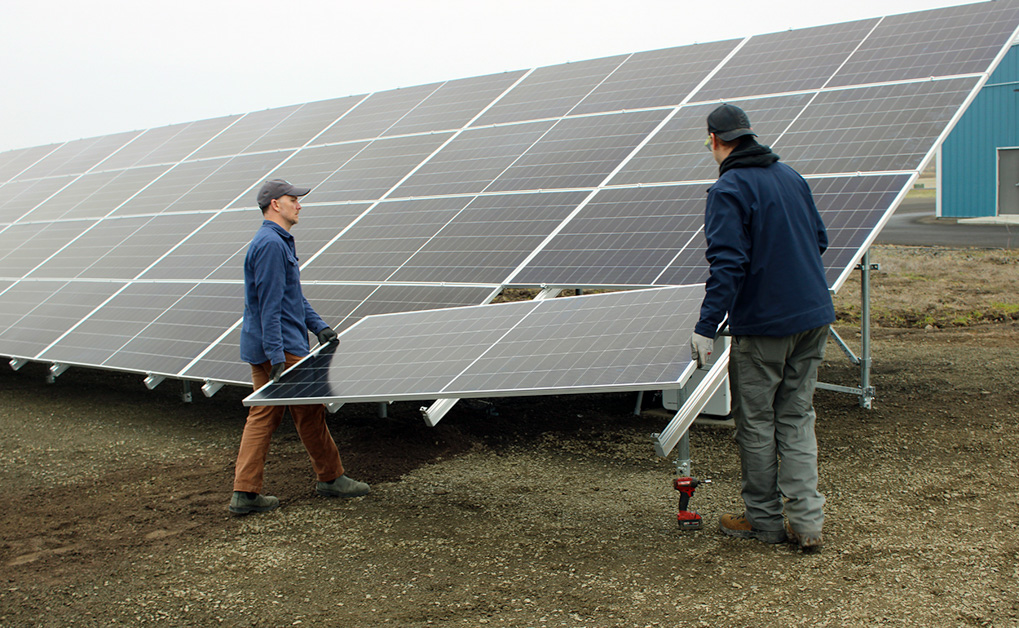
MISSION – The Confederated Tribes of the Umatilla Indian Reservation (CTUIR) took another step forward with renewable energy when workers on Feb. 4 installed the last of 200 solar panels at the Tutuilla Food Sovereignty Center.
Patrick Mills, CTUIR Department of Economic and Community Development (DECD) climate coordination analyst, said four solar photovoltaic (PV) arrays – two arrays with 52 solar panels and two with 48 panels – were installed behind the 10,500-square-foot building to offset its average annual electricity bill.
“The building uses a relatively large amount of electricity due to the refrigeration and freezer units for food storage inside. We estimate the solar PV array system will save the CTUIR more than $16,000 per year on electricity bills,” Mills said. The food center is part of the CTUIR’s Food Distribution Program on Indian Reservations and is at 46678 Tokti Road. “Annual electricity bill costs for the building ranged from $10,482 to $17,880 between years 2022 and 2024. It’s important to note that electricity rates are rising so the annual cost savings could, in theory, be much greater as time goes by.”
Based on an analysis of electricity bills spanning from July 2021 to February 2025, DECD officials estimated the building uses upwards of 149,000 kilowatt-hours (kWh) of electricity annually. Mills said the 200 panels should generate an estimated 176,125 kWh annually. According to the U.S. Energy Information Administration, the average U.S. house uses slightly more than 10,500 kWh per year.
“Production will go down some over time due to panel degradation and other factors. To account for this and the possibility of increased building electricity demand over time, we intentionally oversized the solar PV array system by about 18%,” Mills said.
The project’s origins stem from a 2022 resolution passed by the Board of Trustees to reduce electricity costs for tribal facilities by deploying non-greenhouse gas-emitting power generation technologies that tie into the CTUIR’s Strategic Energy Plan.
“The building uses a relatively large amount of electricity due to the refrigeration and freezer units for food storage inside. We estimate the solar PV array system will save the CTUIR more than $16,000 per year on electricity bills.”
Patrick Mills, Department of Economic and Community Development, climate coordination analyst
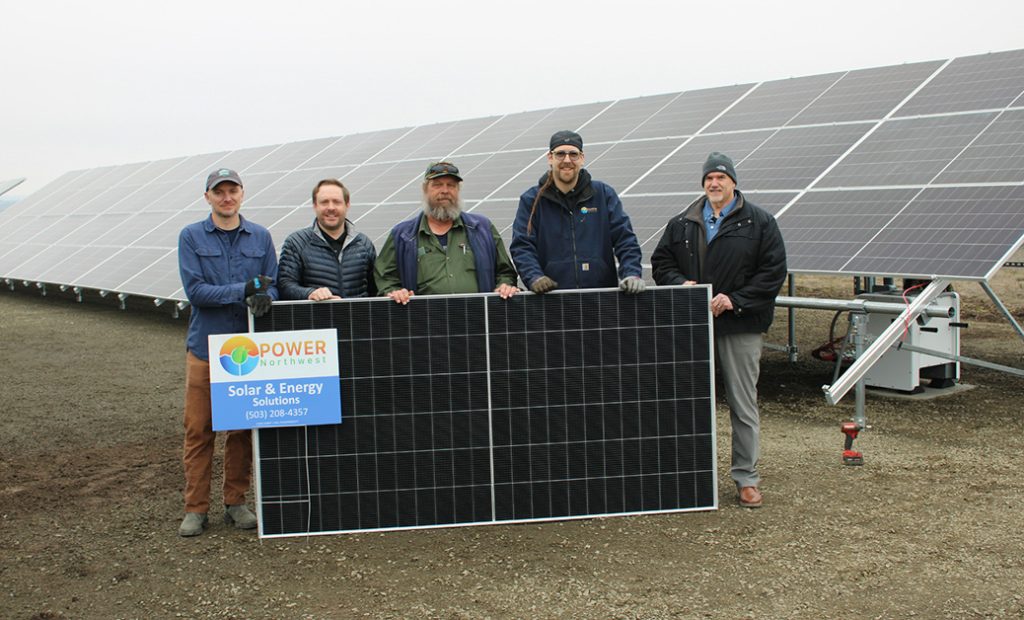
DECD managed the project while Power Northwest out of Portland served as the prime solar engineering, procurement and construction contractor. Bryson Picard Grading & Excavating, a CTUIR tribal member-owned business, was hired for pre-construction site work such as service road and array pad preparation.
The CTUIR’s Tribal Employment Rights Office supported construction activities, while the Department of Natural Cultural Resources Protection Program provided cultural resource investigation and monitoring services. The CTUIR Planning Office handled the development permit and all inspections.
Mills said the pre-construction site prep work was finished within several days and the solar PV array system construction and installation took about 10 days. A perimeter fence was expected to be added to the site, he added.
“We anticipate the solar PV array system will be energized and reducing electricity costs for the tribe within two weeks, by Feb. 18,” he said. “Pacific Power still needs to install the ‘smart’ power meter, and an additional placard needs installed on some electrical gear as a final inspection requirement that was flagged.”
Mills said the total project cost is estimated at around $370,000 with all of it being covered with grant funding awarded to the CTUIR through the Washington Climate Commitment Act or CCA.
“We have secured a financial incentive from the Energy Trust of Oregon that will reduce this cost by $50,000, so the final total cost with offsets will be closer to $320,000,” he said.