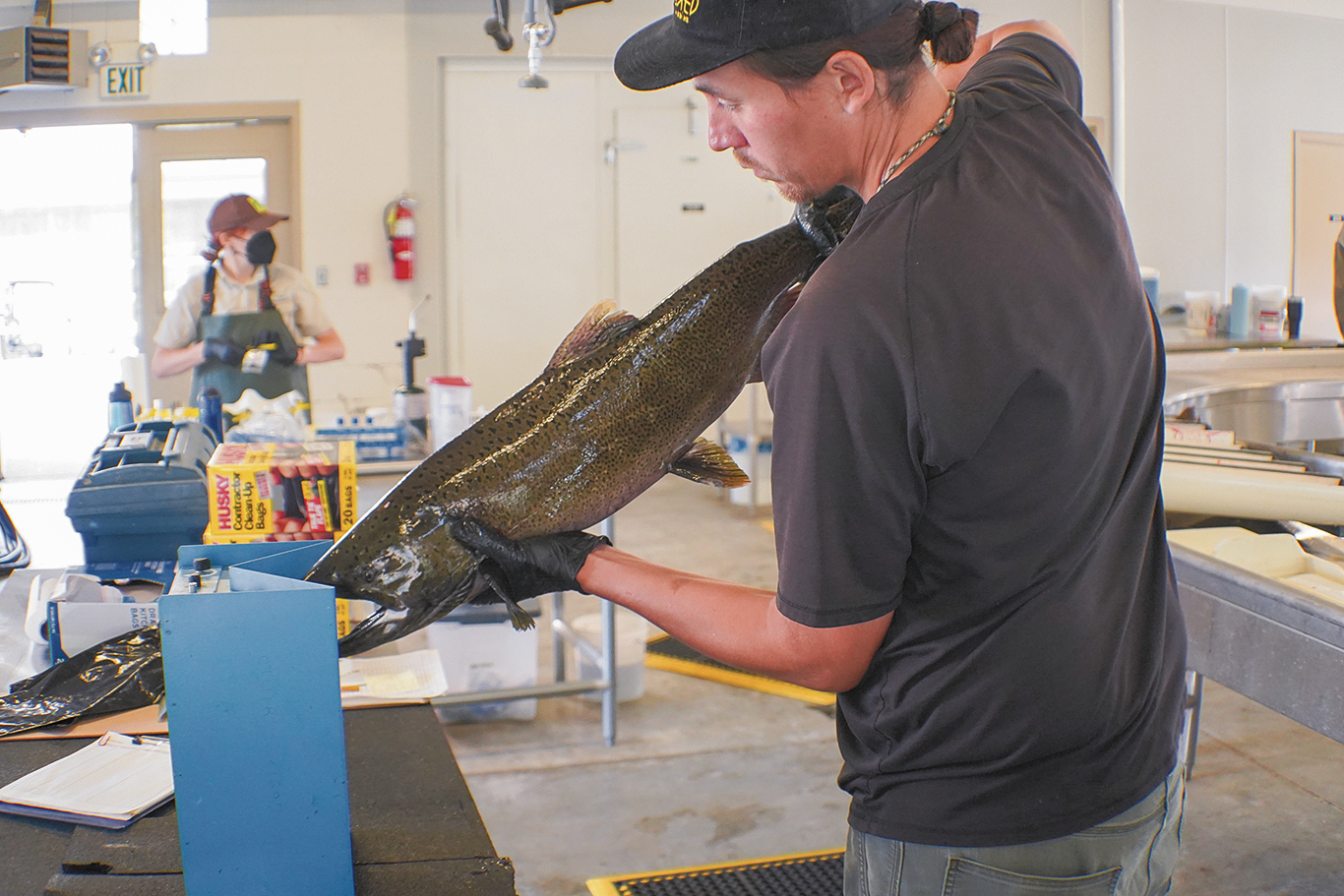
MISSION – The Confederated Tribes of the Umatilla Indian Reservation (CTUIR) has been awarded $6.91 million from the U.S. Bureau of Indian Affairs (BIA) for fish hatchery and collection activities.
Jerimiah Bonifer, Fisheries Program manager with CTUIR’s Department of Natural Resources (DNR), said the CTUIR in March received notice of the BIA funding appropriated in the Inflation Reduction Act of 2022.
“The funds are directly applied to the hatchery facility modernization and maintenance needs, which are necessary to continue to support treaty harvest rights throughout the CTUIR’s usual and accustomed areas,” Bonifer said.
While hatchery infrastructure remains one of the most effective tools used by the Fisheries Program to reintroduce and supplement salmon and steelhead in CTUIR’s traditional use areas, he added.
DNR applied for the funding in 2025 for three hatcheries: the Nursery Bridge Adult Collection Facility near Milton-Freewater, the Umatilla Hatchery Satellite Facility near Irrigon and the ˀImtwaha Fish Hatchery near Walla Walla, Washington.
“At Nursery Bridge, the funds will pay for construction of an improved collection and handling area, which is currently in the design phase,” Bonifer said. “At ˀImtwaha, the funds will support improved internet connectivity, allowing for better connection to the Nixyáawii Governance Center and improved emergency response with the advanced alarm system installed when the facility was completed.”
He said the Umatilla Hatchery Satellite Facility is the oldest and includes the Immeques (em-meck-eez) Acclimation site near Gibbon, Thornhollow Acclimation site near Cayuse and Three Mile Dam Adult Collection site near Umatilla.
Bonifer said all sites are budgeted for internet upgrades. He noted the sites, along with the Pendleton acclimation site, will also receive intake cleaning system upgrades or replacements, water control valve replacements or rebuilds and intake flow meters.
He said the updates will also improve water-use reporting, strengthen alarm-system connectivity, and enhance the ability to maintain intakes during inclement weather, allowing staff to more securely hold fish.
Although the CTUIR has yet to receive the funds, work should begin when the money is transferred. Some projects, such as internet upgrades, should be completed within a year of their start dates, Bonifer said, while others may require longer timelines to ensure usability when needed.
For example, work at Nursery Bridge is not expected to start until 2027 or 2028 because of the unfinished redesign and time needed to use the facility for its purpose and to find a contractor for the project.
“Valve replacements and flow meter installations are again constrained by the funding arrival and bid process, but also the facilities need to be vacant for the work to happen,” Bonifer said. “Intake cleaning system replacements will need to happen during the summer months, likely in 2027.”
Despite lengthy times estimated for some projects, Bonifer said the CTUIR is thankful for the BIA funds because hatchery facilities are subject to high levels of wear and tear.
“Water is constantly working to destroy the concrete of which many facilities are made, their technology and mechanical parts,” he said. “Since we are also working with live animals, it is important to ensure that our facilities are able to safely hold and maintain the fish. Sometimes the only thing that prioritizes a repair is a catastrophic failure. This funding allows us to address areas where we haven’t yet had a failure, but if we keep delaying maintenance activities, we may. Ultimately, it provides us with peace of mind and security for the over four million fish the artificial production program releases each year.”