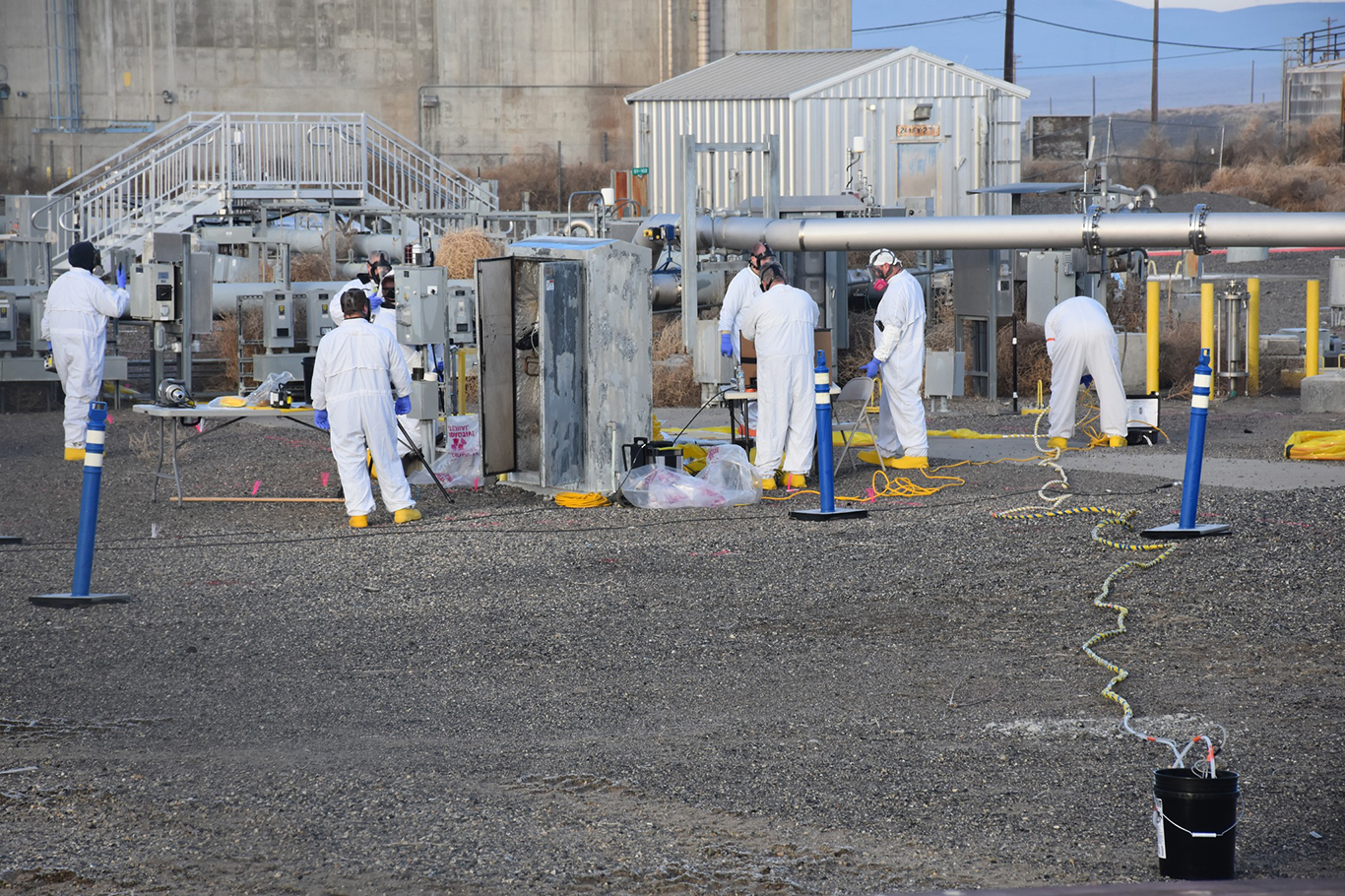
MISSION — A virtual town hall will take place on June 17 to allow members of the Confederated Tribes of the Umatilla Indian Reservation (CTUIR) the opportunity to voice their opinions to their elected officials about nuclear development — a longstanding issue since the Hanford Nuclear Reservation became the site of the first full-scale plutonium reactor in 1943.
“CTUIR leadership have felt that it’s important to have a community discussion about what U.S. Energy Secretary Chris Wright has called the ‘nuclear energy renaissance,’ and how to potentially update its policies to respond to that,” CTUIR Legislative Affairs Manager Sterling Cosper said.
In February 2025, Wright signed a secretarial order aimed at “Unleash the Golden Era of American Energy Dominance,” in accordance with President Trump’s executive orders.
“As global energy demand continues to grow, America must lead the commercialization of affordable and abundant nuclear energy,” Wright said in the secretarial order. “As such, the Department will work diligently and creatively to enable the rapid deployment and export of next-generation nuclear technology.”
Cosper said, with the Hanford site being within CTUIR ceded territory, nuclear energy has been a longstanding issue impacting treaty rights and the natural environment of First Foods.
In 1980, Ballot Measure 7 was passed by Oregon voters, halting the creation or storage of new nuclear waste until there was a permanent waste repository. As recently as 2025, there have been efforts to restore a focus on nuclear energy intended to repeal Ballot Measure 7; no bills have been passed in the state of Oregon.
Cosper said the motivation to set the revival of nuclear energy relates to the increasing number of hyperscale data centers in the region and across the country, intended to support artificial intelligence development.
“As from what we’ve gathered, they are placing a substantial new strain on a power system that has already faced longstanding challenges, which is why nuclear is back in the public conversation,” Cosper said.
The CTUIR is keeping the topic of nuclear energy at the forefront of tribal members’ minds by inviting them to participate in the town hall, set to take place virtually on June 17.
Cosper said CTUIR elected officials are doing the town hall and a related survey to get a better sense from tribal members about how they feel about nuclear energy and the first comprehensive CTUIR policy to address it.
“A big point of the town halls, I think, is to inform members specifically what the CTUIR government is trying to accomplish with this new policy effort, including what it actually states,” Cosper said.
The Draft Nuclear Policy Survey is intended to complement the town hall. Cosper noted that some tribal members would be more comfortable voicing their thoughts and opinions in an anonymous format or feel they can better communicate that way.
“This is not only to share their general take on the policy, but they may also think of something that the CTUIR team hasn’t,” he said.
Within the survey is supplemental information about the history the CTUIR shares with nuclear energy development, as well as a summary of the draft Policy. In the draft are the overarching goals of the policy, what the tribe opposes pertaining to nuclear energy development, plans for oversight, mitigation of negative impacts, monitoring and more.
Survey participants will have the opportunity to give their opinions on the CTUIR’s Nuclear Policy, the need for preparedness of strategic representation, their support or lack thereof pertaining to nuclear energy, the most concerning aspects of it and the most beneficial. In addition to the survey, survey participants can submit additional questions or comments they would like to see discussed at the June 17 virtual Town Hall.
To take the survey, participants can visit: https://rb.gy/6hfz4t
CTUIR Nuclear Timeline
1940–1985
- 1943 – The Hanford Nuclear Reservation (Hanford) became the site of the first full-scale plutonium reactor. Waste accumulated there and was poorly managed, leading to ongoing issues that continued to be mitigated.
- 1972 – Construction began on the Columbia Generating Station (CGS), the only commercial nuclear reactor completed at Hanford.
- 1980 – Oregon voters approved Ballot Measure 7, restricting new nuclear waste generation or storage without a permanent national repository and requiring voter involvement in nuclear facility siting.
- 1983 – The 1982 Nuclear Waste Policy Act recognized the CTUIR as an affected tribe whose reservation contained a radioactive waste repository or whose treaty-defined rights on land outside its reservation were adversely affected by a nuclear facility.
- 1984 – The CGS began providing more than 1,200 megawatts (MW) of electricity to the regional grid. As of 2026, it remained Hanford’s only operational nuclear plant.
2000–2010
- 2001 – The Western energy crisis affected the Bonneville Power Administration (BPA), which contributed to major financial losses and reduced funding for fish and wildlife programs.
- 2003 – The Columbia River Inter-Tribal Fish Commission (CRITFC) published an Energy Vision emphasizing protection of salmon and opposition to harmful energy development.
- 2007 – CTUIR adopted its Hanford Policy, opposing new nuclear development at Hanford without tribal consent and requiring safe disposal of high-level waste in a national repository.
- 2009 – The CTUIR Board of Trustees (BOT) adopted an energy policy guiding energy development and responses to regional energy issues. The policy incorporated language from the CRITFC and the Affiliated Tribes of Northwest Indians (ATNI), and referenced the CTUIR Hanford Policy in its nuclear provisions.
2019–2023
- 2019 – Washington Gov. Jay Inslee signed the Clean Energy Transformation Act (CETA), which required Washington’s electricity supply to be carbon-free by 2045.
- 2021 – The Washington Climate Commitment Act (CCA) was enacted to support emissions reductions under CETA. The CTUIR opposed SMNR development at Hanford due to unresolved nuclear waste and environmental concerns and circulated its Hanford Policy to federal and state agencies, conditioning any deployment on a permanent waste repository.
- 2022 – The CTUIR continued monitoring SMNR development and engaged federal officials, including the U.S. Department of Energy, on Hanford-related issues. The Tribe reiterated its opposition to new nuclear development absent a national waste storage solution and emphasized concerns about ecological impacts and site safety. The CTUIR also adopted the CRITFC Energy Vision, which advised against new nuclear missions at Hanford without tribal consultation and consent.
- 2023 – Oregon legislation seeking to ease restrictions on nuclear energy development failed to advance. X-energy proposed an SMNR project at Hanford in partnership with Energy Northwest and Amazon, but later withdrew the proposal following opposition from the CTUIR and Columbia Riverkeeper.
2024
- Feb. 7 – The CTUIR sent a letter to the Washington Legislature opposing development of small modular nuclear reactors (SMNRs) at the Hanford site.
- March 6 – Energy Northwest sought CCA funding for an SMNR project at Hanford. Washington lawmakers approved a $25 million capital budget allocation for SMNR development.
- March 27–29 – The CTUIR and Columbia Riverkeeper requested a veto of the $25 million allocation. Gov. Jay Inslee signed the state budget, including the funding.
- Sept. 26 – The Washington Department of Commerce notified the CTUIR regarding consultation requirements tied to releasing the $25 million in SMNR funding, stating that consultation must be initiated before funds can be released.
- October – Amazon announced plans tied to SMNR development at Hanford to support data centers in Oregon’s Umatilla and Morrow counties, while Oregon’s nuclear moratorium remained in place.
2025
- Jan. 3 – CTUIR leaders met with Washington legislators to discuss small modular nuclear reactors (SMNRs), beginning development of a tribal nuclear policy.
- Feb. 12–24 – Washington Commerce requested formal tribal consultation on funding tied to Energy Northwest’s proposed SMNR project. CTUIR directed staff to initiate consultation.
- Feb.– March – Oregon lawmakers considered multiple nuclear-related bills, including proposals for an SMNR demonstration project in Umatilla County and state-level nuclear energy studies. The CTUIR provided testimony expressing concerns and requesting formal consultation.
- April – Key nuclear-related bills stalled in committee before the legislative session ended.
- May 5 – Energy Northwest, Amazon, X-energy and Washington Commerce presented the SMNR proposal to the BOT. The CTUIR stated the meeting did not constitute formal consultation, citing unresolved questions about state funding and tribal consultation requirements.
- May 23 – The Trump administration issued executive orders promoting nuclear energy expansion, including faster reactor licensing and increased domestic nuclear fuel production.
- July – The CTUIR began drafting a formal nuclear energy policy informed by prior tribal positions and regional energy developments.
- Oct. 14–16 – Washington Commerce and Energy Northwest advanced consultation discussions and announced the Hanford SMNR project.
- Nov. 5 – Washington voters rejected Initiative 2117, preserving the state’s Climate Commitment Act, which supported clean energy funding, including nuclear-related proposals.
2026
- January – The CTUIR began planning town halls to present its draft nuclear policy to tribal members, targeting June 18 for presentation to the General Council, with opportunities for public input. Washington and Oregon lawmakers introduced multiple bills related to nuclear energy and state energy strategy, including proposals to expand nuclear power and allow municipal contracting for nuclear energy. The CTUIR also worked with Oregon Rep. Bobby Levy on legislation to include protections for tribal interests.
- Jan. 13 and 15 – CTUIR General Council Chairman Lindsey X. Watchman and Trustee Lisa Ganuelas testified against Washington nuclear energy legislation (HB 2090/SB 5821), urging formal tribal consultation prior to project approvals and raising concerns about past energy development impacts and project timelines.
- Mid–late January – Energy Northwest requested an additional $50 million in CCA funding through Washington’s capital budget process to support SMNR development, administered by Washington Commerce.
- Jan. 25 – The Washington Democratic Central Committee passed a resolution opposing HB 2090/SB 5821, citing tribal testimony from the CTUIR and Yakama Nation, concerns over nuclear project cost overruns, potential impacts on utility rates, and prioritization of energy for data centers and artificial intelligence.
- Feb. 6 – The BOT sent a letter to Washington lawmakers requesting the denial of Energy Northwest’s proposed $50 million in CCA funding.
- Feb. 12 – CTUIR staff filed a complaint with the Washington Governor’s Office of Indian Affairs regarding Washington Commerce’s handling of CCA funding related to the SMNR proposal.
- Feb. 23 – Washington’s capital budget entered House committee review, with the CTUIR monitoring whether Energy Northwest’s requested funding was included.