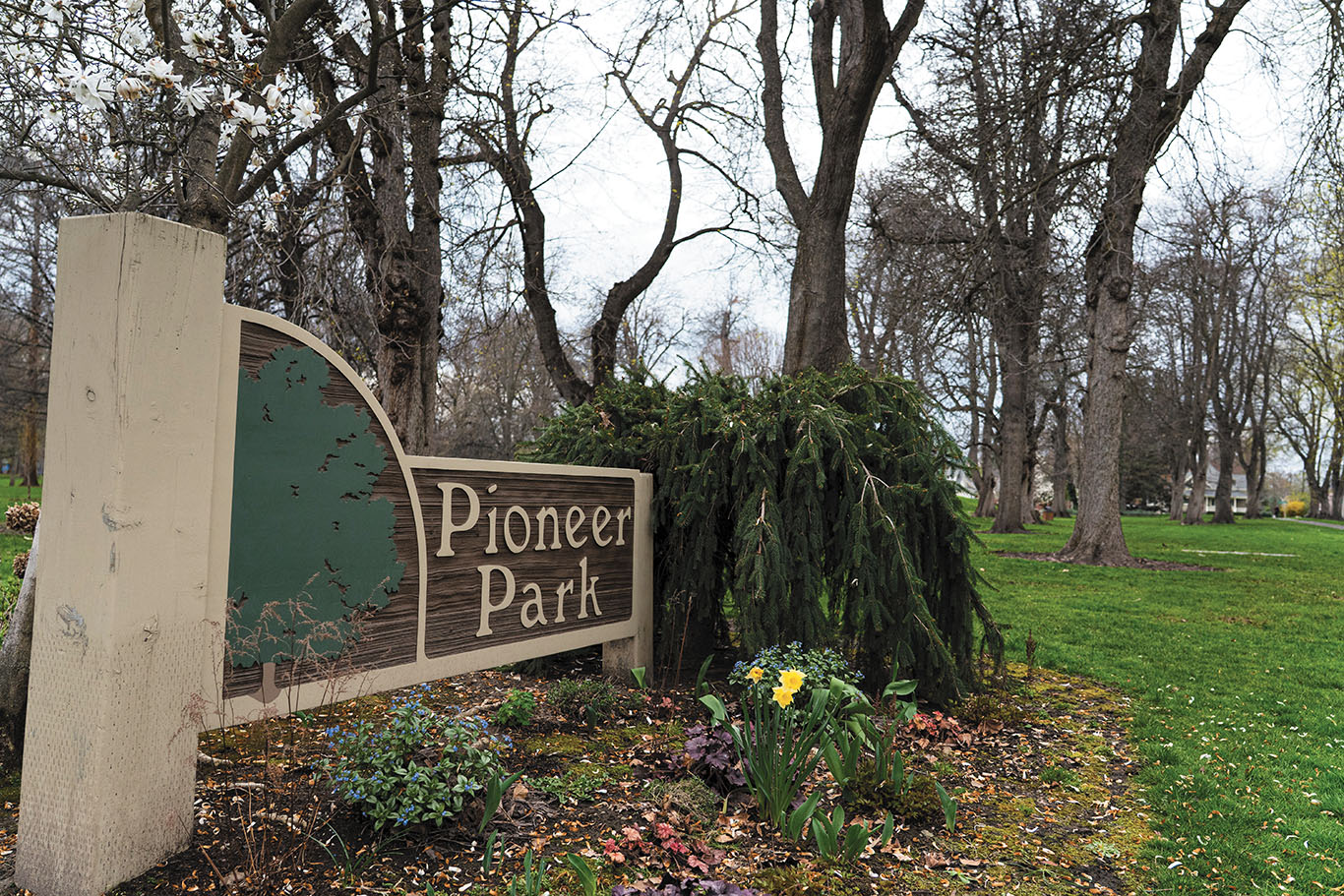
WALLA WALLA — More than a year after crews uncovered a Native American burial site during sidewalk improvements at Pioneer Park, ancestral remains have yet to be returned to their resting place.
The Confederated Tribes of the Umatilla Indian Reservation (CTUIR) Board of Trustees (BOT) sent a letter to the city of Walla Walla and the Washington Transportation Improvement Board (WTIB) on Jan. 31, expressing frustration over the discovery and how officials have handled it.
The contractor exposed the ancestral remains on Dec. 6, 2024, while working on a Pioneer Park and Whitman Street project. Workers did not identify them as human remains until two days later, when two individuals posted photos on social media, drawing the Walla Walla Police Department’s attention.
Dirt from the excavation where the ancestor had been found was placed at different locations along the street, and the city hired an archaeological firm to conduct screenings, CTUIR Cultural Resources Protection Program Manager Teara Farrow Ferman said.
While the remains are held In Olympia, the city-hired archaeologist must rebuild the retaining wall from which the ancestor was discovered, which should be happening soon, said Farrow Ferman.
“Then we’ll rebury the ancestor with some protective measures placed on top of the ancestor,” she said.
After Washington State Physical Anthropologist Guy Tasa confirmed the remains were Native American, the CTUIR and Yakama Nation sought to work with the state to address the discovery, meeting with the city for the first time on Jan. 13, 2025.
The BOT said the city did not consult with the tribes on potential cultural resource impacts for the WTIB-funded project, citing Gov. Jay Inslee’s Executive Order 2021-02. It also said the city was not following its 2023 Historic Preservation Plan for consultation with CTUIR.
“The City of Walla Walla should be aware of the long, troubling history of the routine and casual excavation of tribal burials that has occurred over the last two centuries, including a significant black market for tribal artifacts, something we could have discussed given the opportunity for consultation,” the BOT stated in its letter.
On Dec. 23, 2024, the city government posted a Facebook update with burial site photos, stating the area had been designated an archaeological site. While the photos have been removed, the post remains and has been shared approximately 100 times.
“We have found whenever tribal burials are identified publicly, people tend to visit those sites in search of artifacts,” the BOT wrote. “Given that the discovery site was located at a public park with high pedestrian traffic that was not adequately protected until after the January 13 meeting, disclosure of the location is unacceptable.”
The handling of the discovery left the BOT with questions for the city, including why tribal consultation wasn’t sought, why a cultural resource monitor wasn’t on site, why excavation continued after bones were uncovered and whether the contractor was aware of the inadvertent discovery policy and its requirements.
The BOT suggested solutions such as proper consultation with the tribes and the Washington Department of Archaeology and Historic Preservation, rather than delegating to an entity without tribal consultation experience as well as ensuring contractors have the expertise to comply with the law in such cases.
“The CTUIR member tribes and our ancestors have occupied the area that is the Walla Walla Valley since time immemorial,” the BOT wrote. “Many of our ancestors remain buried on lands within the city of Walla Walla. We hope that our work together on this incident and the full implementation of your Historic Preservation Plan will reduce the likelihood of future incidents such as these on all city-led projects.”