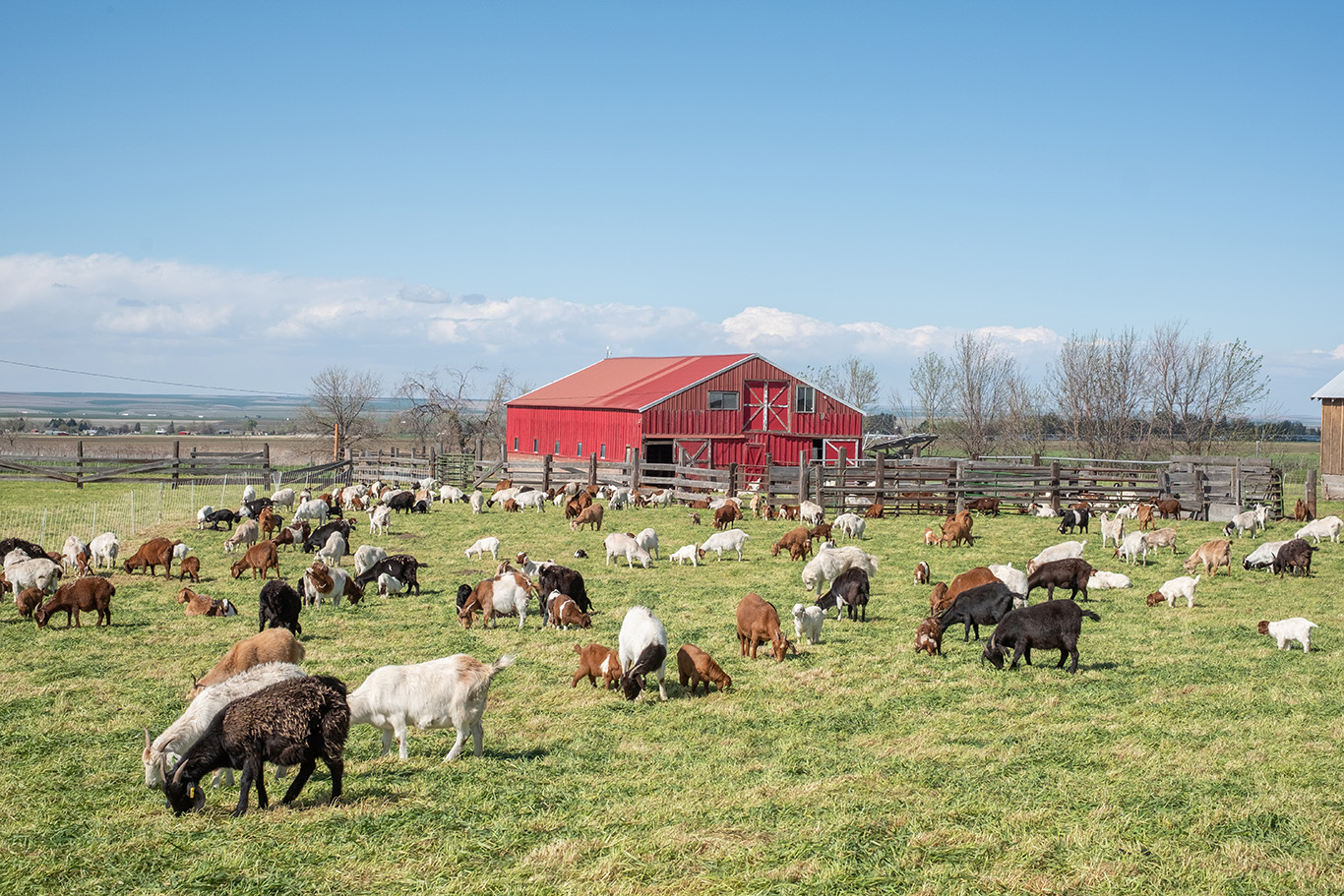
MISSION — A herd of horned heroes has returned to the Umatilla Indian Reservation, grazing the fields with their small hooves and bleating calls.
Outside on a sunny afternoon, hundreds of goats were seen eating weeds and shrubs on April 15 at Nash Ranch on Best Road in Mission.
“Anytime you can use animals to control weeds, for example, grazing volunteer wheat that comes up in summer or fall, you’re feeding the animal while managing the field,” said Mae “Koko” Hufford, land project manager for the Department of Economic and Community Development for the Confederated Tribes of the Umatilla Indian Reservation (CTUIR).
She said grazing offers an alternative to chemical treatments, which some community members worry could have long-term effects.
“We don’t fully know how those chemicals will affect us over time or how they might impact our water supply,” Hufford said. “Using animals provides a different approach that can benefit the community.”
In the field, goats spread across the roping arena, the farm and the surrounding areas, grazing on broadleaf weeds and reducing tall grass that could become a fire hazard.
Jerry Kropf, owner of the goat herd, said the goats are being used in the area to clear vegetation, control weeds and reduce wildfire risk, while also managing noxious weeds and dense vegetation without herbicides.
“ We’re also taking down a bunch of grass that was getting tall and could pose a wildfire threat,” he said.
Although preventing wildfire is not the primary goal on the farm, this wouldn’t be the first time goats have been used to help reduce wildfire risk. Last year, more than 700 of the animals were deployed across Pendleton to graze on dry brush and invasive plants for the Pendleton Fire Department (PFD).
The fire department used multiple funding sources for the effort, including a $55,000 grant from the Community Wildfire Risk Reduction Program, administered through the Oregon State Fire Marshal’s Office.
In coordination with the PFD, goats were especially effective on steep terrain and hard-to-reach areas where mowing equipment cannot operate.
Kropf said fire crews targeted overgrown empty lots and steep hillsides in and around the city that could not be easily maintained with traditional equipment, clearing about 85 acres last year. The animals are often deployed on slopes, vacant lots and other overgrown spaces that are difficult or unsafe for tractors and mowers.
The advantage of goats over mowing, he noted, is that they consume vegetation rather than simply cutting it down, leaving little behind.
“When they’re done, there’s very little left,” Kropf said. “Mowing is good, but you still have residue on the ground. It’s chopped up, but it’s still there, and it can still pose a fire hazard.”
Kropf added that the goats are also being used in wheat fields where herbicide applications failed to fully eliminate unwanted growth.
“The spray didn’t kill it properly, so there’s a lot of foliage that will be hard to work down,” he said. “We’ll graze it off so they can work the fields easily without any chemicals.”
Kropf said goats are not a cure-all for land management issues, but are highly effective at reducing brush and invasive vegetation. He said the animals are particularly useful in dense blackberry thickets, where they strip foliage and clear access for follow-up removal.
“They’re very good at taking down brush,” Kropf said. “They prefer blackberries. They’ll go in there and strip all the leaves off and then it makes it easier to get in there and take things out.”
He said repeated grazing over several years can also help reduce persistent noxious weeds such as yellow star thistle by targeting plants before they go to seed. The goats consume flower heads and seeds, and their activity can help reduce the number of viable seeds left in the soil over time.
“If you keep on it for four years in a row, you get to where there’s very few viable seeds left in the soil,” he said.
Kropf added that the approach is part of a broader effort to reduce reliance on chemical treatments in land management. The herd began work on March 31 and is expected to continue grazing the fields through mid-May.