Group will explore blood quantum and enrollment options
MISSION — A General Council task force will be formed to explore the future of blood quantum enrollment for the Confederated Tribes of the Umatilla Indian Reservation (CTUIR) members.
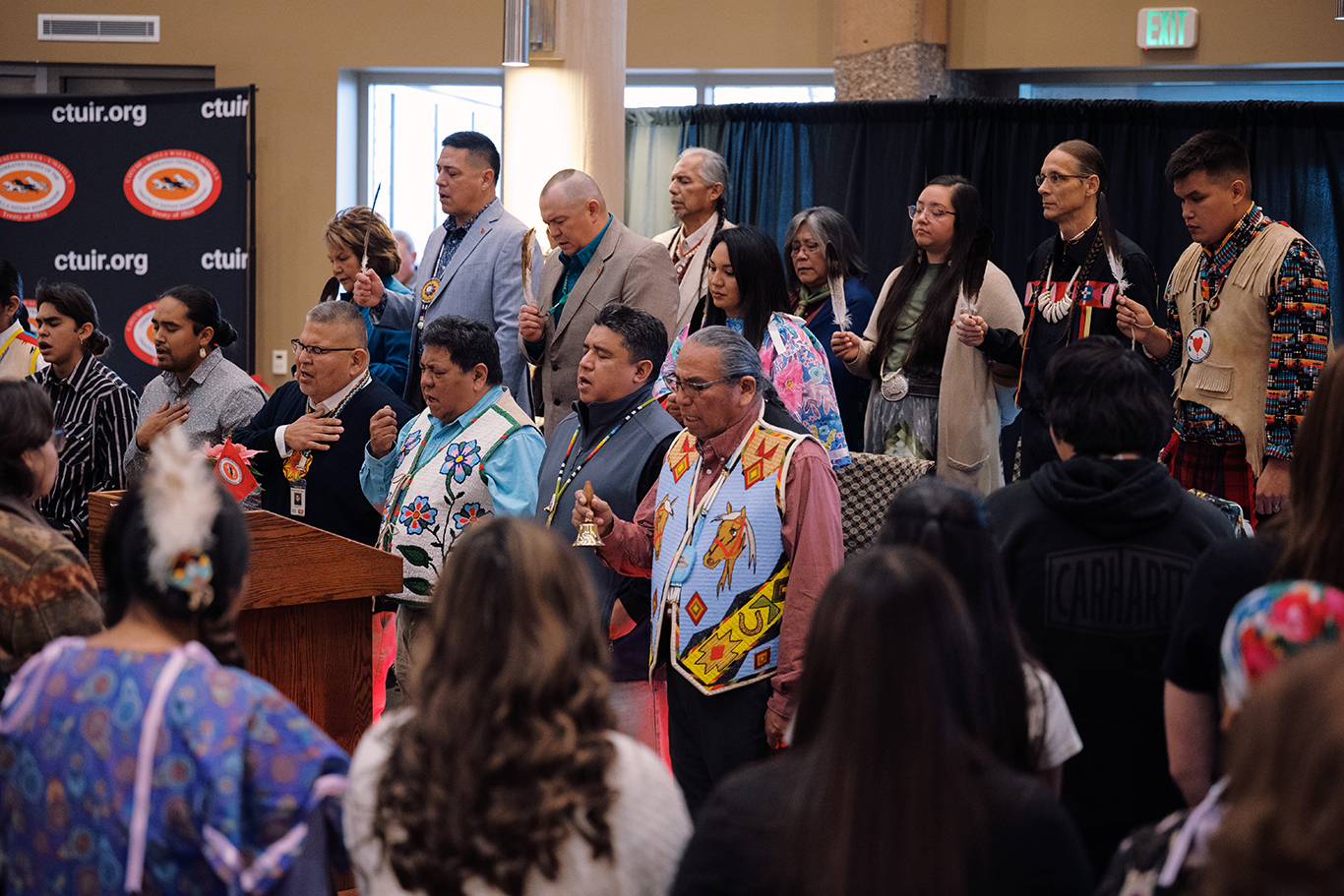
The General Council met Aug. 20 for its monthly meeting at the Nixyáawii Governance Center. More than 150 tribal members attended in person and online to hear a presentation from the Taylor Policy Group on the CTUIR’s demographic data and projections for possible future outcomes.
The CTUIR, made up of the Cayuse, Walla Walla and Umatilla tribes, has seen a decline in membership the past four years.
According to Enrollment, in 2022, the CTUIR had about 3,232 enrolled members. Enrollment dipped by one member in 2023 to 3,231. However, the decline became more noticeable in 2024 when enrollment fell to 3,206, before slipping again in 2025 to 3,193 members.
The options discussed included maintaining the current enrollment standard of one-fourth blood quantum or lowering it to one-eighth or one-sixteenth, as well as considering lineal descent.
General Council Chairman Lindsey X. Watchman said he and the General Council wanted to see the data figures presented for the first time during the meeting alongside the public, ensuring everyone received the same information together and in real time.
Watchman noted that projections made 25 years ago now appear to be coming to pass.
“Now we have more current data, enrollment data and a second company here, Taylor Policy Group, providing new visual aids that show, essentially by generational cohorts, what happens if nothing happens,” he said.
Doing nothing is one of the options being discussed and could eventually be presented to voters if the issue makes it to the November 2027 ballot, Watchman said.
“But we need to identify two to three other options for the voters at that time to choose from,” Watchman said.
Along with the question of whether to lower the one-fourth blood quantum threshold, members are considering how a larger enrollment could affect tribal dividends, hunting, fishing, education and health care. Others, however, see the change as an opportunity for family members who currently do not qualify to become eligible for enrollment.
More than 100 tribal members commented on the General Council’s Facebook post announcing the meeting. Some opposed lowering the enrollment requirements, while others supported the change.
One tribal member wrote, “Let’s not lower it. That’s a mistake.” Another wrote, “Don’t lower it. It will ruin us for sure.”
CTUIR member DeArcie Abraham wrote that blood quantum is a colonial construct that could contribute to the tribe’s decline. Decolonization means rejecting colonial ways of thinking and she noted that her children fall just short of the current one-fourth requirement.
Abraham also wrote that her children would have a much higher blood quantum if First Nations and other Indigenous ancestry were included in the calculation.
CTUIR member Jeanine Gordon wrote that population is a fundamental base for a strong nation, providing workforce, leadership, knowledge, skills and more, which is needed for national power. She added that culture and traditions are a fundamental base for a strong nation’s identity, deep sense of belonging and deep sense of responsibility to pass on and teach culture and traditions to keep it alive for future generations. Blood quantum math is a colonizer tool, not a cultural or traditional practice, Gordon said.
During the meeting, General Council Secretary Shawna Gavin said members appeared to respond positively to that approach and appreciated the thoughtful discussion, noting that many had been considering the issue for years.
Gavin noted the Taylor Policy Group presented the data without advocating for a particular outcome. The neutral presentation, she said, allowed members to consider the numbers and options without being guided toward a specific direction.
Toward the end of the meeting, the General Council voted to form a task force to provide educational information to the community and develop two to four options for the November 2027 ballot. Depending on how the process unfolds, the ballot measure could be pushed to November 2029, Watchman noted.
In the meantime, the General Council is seeking volunteers to serve on the task force.
Watchman said the task force would use the months leading up to the ballot deadline to present educational information and provide a comprehensive list of frequently asked questions. The task force could refine the ballot options or develop different options as more information becomes available.
“Bottom line is, we can’t kick the can down the road any further,” Watchman said.