ELGIN — The Confederated Tribes of the Umatilla Indian Reservation (CTUIR) and its partners are singing the praises of a new fish ladder at the Lookingglass Fish Hatchery on Lookingglass and Jarboe creeks.
Rod Engle, fish biologist-science coordinator for the U.S. Fish and Wildlife Service’s (USFW) Lower Snake River Compensation Plan (LSRCP) Office, said the new ladder replaces one that was smaller and of a different style.
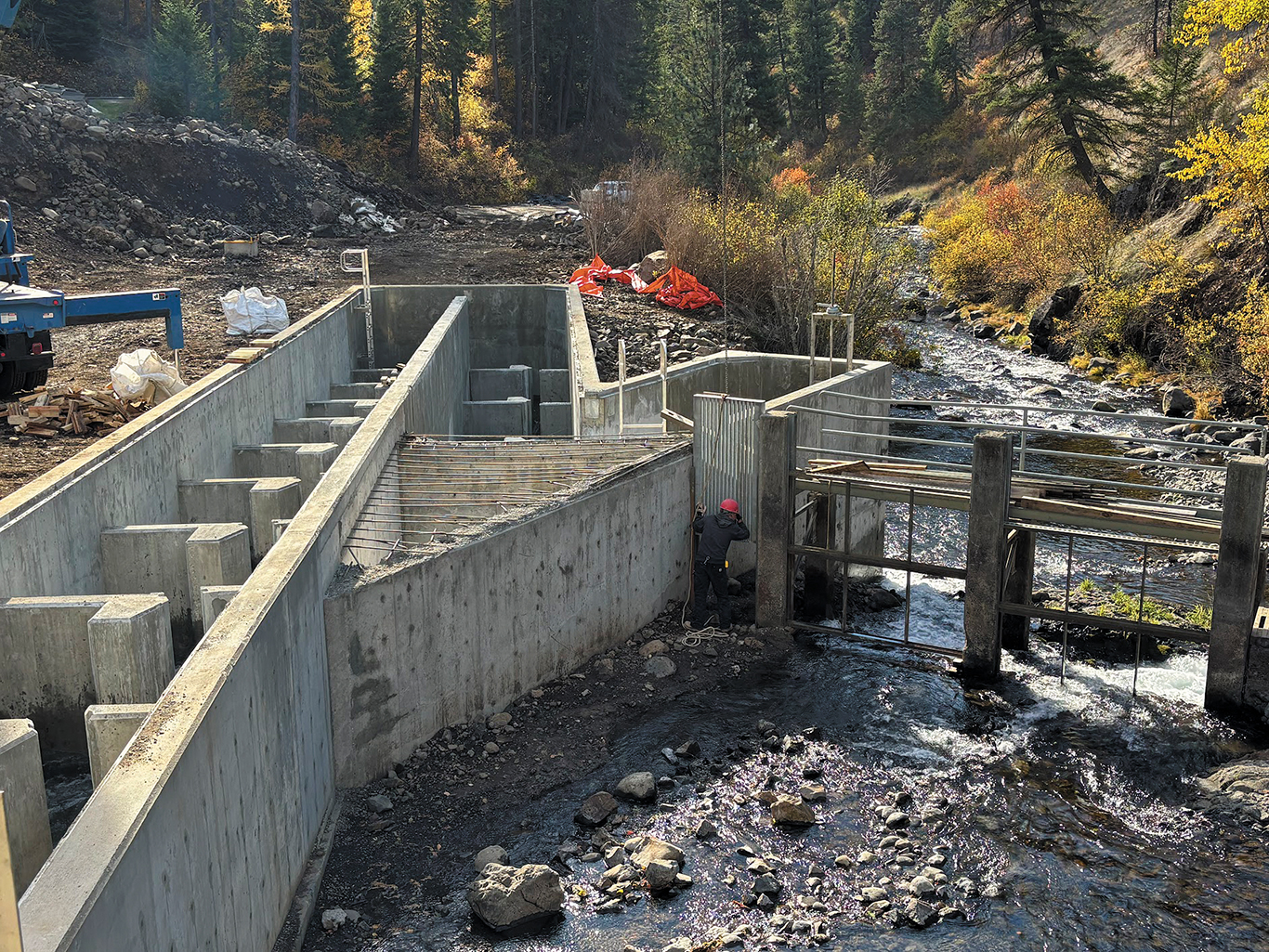
“The elevation gain from the bottom to the top of the ladder is about 10 feet, and the length of the ladder is approximately 120 feet,” he said. “It’s made from 540 cubic yards of concrete, steel and fiberglass rebar and represents a lot of work by engineers, contractors and fish biologists who played parts in its completion.”
Engle said the ladder resembles a meandering walkway with a slotted floor, but within the ladder, there are 5-feet-deep pools with passages between them for fish to “climb.” Fish enter the ladder by being attracted to water flow near the entrance or coming from inside it, he added.
“Once inside, they swim up successive pools connected by narrow slits of flowing water, each pool slightly higher in elevation than the last until they reach the top,” Engle said. “Once at the top pool, they are either collected by the hatchery as brood stock for the next hatchery generation of spring Chinook salmon or passed upstream to continue their spawning journey or migration.”
Jen Krajcik, CTUIR Department of Natural Resources artificial production supervisor, said the old ladder also did not meet Oregon Department of Fish and Wildlife (ODFW) and National Oceanic and Atmospheric Administration (NOAA) fish passage criteria.
“This one does, which will make it easier for both adult and juvenile fish to move up and down the creek,” she said. “The new design allows our staff to work with fish in the trap and pass them directly upstream.”
Krajcik said fish previously had to be removed with a net, moved into a nearby shed before being put in a tank on the back of a truck for release upstream.
“We think that being able to work fish inside the trap will be better for the fish, particularly Endangered Species Act-listed fish like bull trout, and better for our staff,” she said.
The hatchery is operated by the ODFW with co-management by the CTUIR and the Nez Perce Tribe for the fish they raise and release in the Imnaha and Grande Ronde River basins. It was constructed in 1982 to mitigate for spring Chinook and summer steelhead losses caused by four federal dams constructed on the lower Snake River. It’s used to rear spring Chinook for the Grande Ronde and Imnaha rivers and serves as an adult collection, egg incubation and rearing and release site for the spring Chinook destined for the Grande Ronde River systems.
Krajcik said the previous ladder had reached its lifespan and the new ladder’s design should allow better upstream and downstream passage for fish of varying types, sizes and ages within Lookingglass Creek. It also provides fish passage over Lookingglass Falls for adult salmon and steelhead, as well as resident fish such as bull trout or rainbow trout, she said.
Along with the new ladder, the hatchery’s intake screens were replaced, which will keep natural origin fish from entering the hatchery. Engle said it’s highly likely some juvenile and resident fish have already used it and that the return of steelhead spawners was expected in March and April as well as the return of spring Chinook from May to August.
“Pacific Lamprey may also use the ladder or navigate Lookingglass Falls,” he said. “Fish biologists for the USFWS, CTUIR and ODFW expect the ladder to help immediately and the new intake to considerably reduce negative impacts to fish in Lookingglass Creek.”
Although the project’s planning began in 2021, physical work on it didn’t occur until May 2025. The ladder was completed on Oct. 22. The $5.8 million it took to build it stemmed from Bonneville Power Administration (BPA) funds earmarked for high-priority, non-recurring maintenance needs of existing BPA Fish & Wildlife assets, Engle said.
CTUIR staff biologists and technicians helped with the ladder’s design and construction-related monitoring. They will also enumerate and pass steelhead navigating the ladder annually as part of a monitoring project. CTUIR staff also work with the ODFW, collecting spring Chinook for brood stock at the hatchery to ensure continued fishing opportunities.
“CTUIR staff were involved in implementation meetings where they gave input on the timing of adult fish passage through the construction area, offered expertise in helping to design and set up a weir to keep adult fish from entering the work area, monitoring redds when fish were allowed into the work area and offering input into the design of the fish trap that was installed at the ladder,” Krajcik said. “Additionally, they have been active in helping ODFW staff problem solve by making modifications to the trap fyke and grizzly, the ladder grating and working to determine how best to operate the trap.”
Krajcik said the CTUIR Fish & Wildlife Commission has requested to hold a blessing ceremony for the new fish ladder at the hatchery in April before the spring Chinook salmon return.