MISSION — Six Nixyáawii Community School (NCS) students will have the opportunity to travel to Yellowstone National Park to camp and hike throughout West Yellowstone, visiting multiple geysers and springs during their week-long trip.
This opportunity comes after donations from Change X, a nonprofit supported by Microsoft and Amazon, and Yellowhawk Tribal Health Center (Yellowhawk) paid a portion of the $16,000 in travel costs, said Aaron Noisey, NCS physical education/health teacher/athletic director.
“Some of the kids have never been able to do anything like this,” Noisey said. “We want to thank our community, the Change X group, Yellowhawk and the community support that the kids have gotten by supporting their fundraising efforts to be able to do this.”
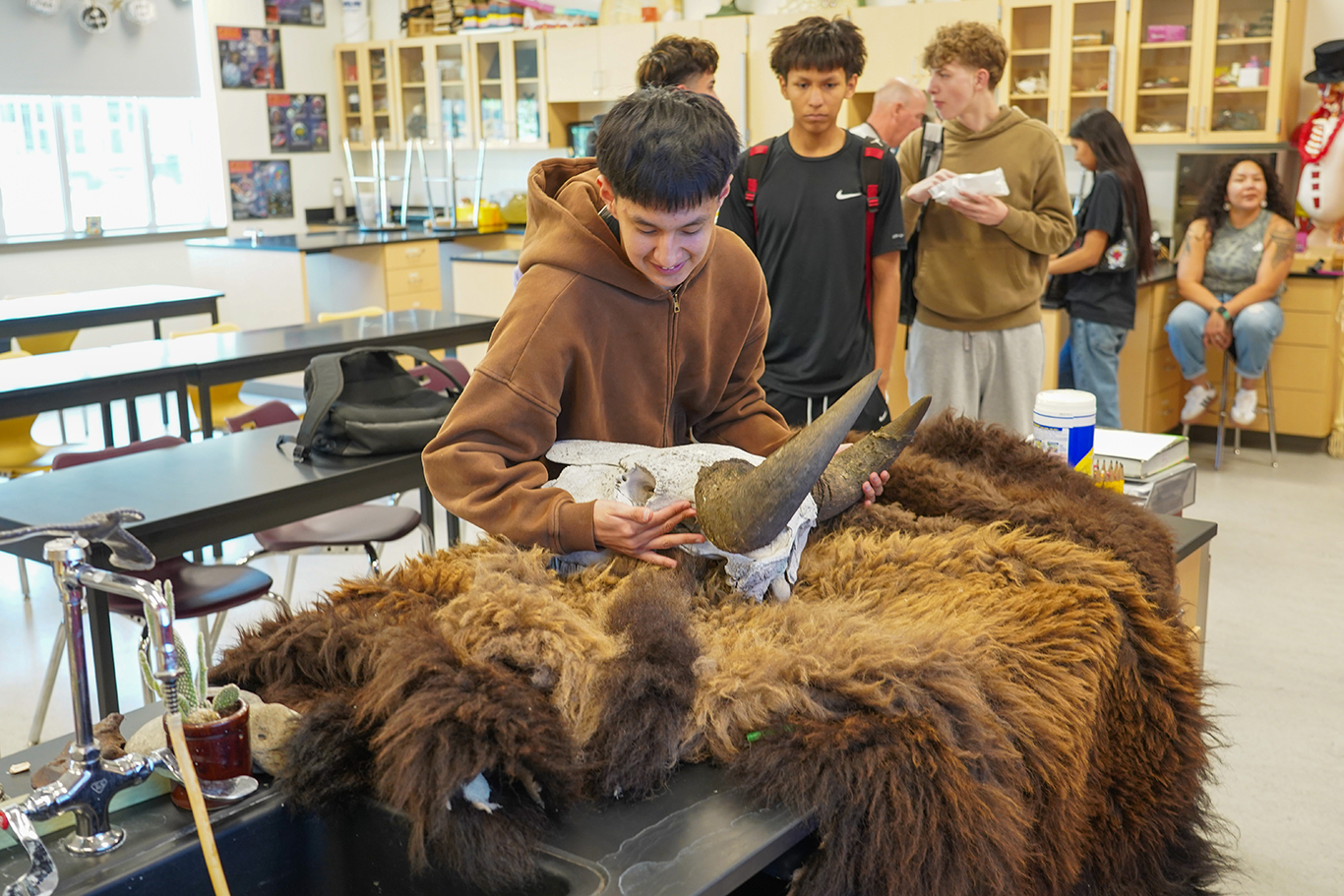
On May 21, multiple speakers gathered at NCS to inform students about their treaty rights and how to safely exercise them, as the Confederated Tribes of the Umatilla Indian Reservation (CTUIR) is one of eight tribes permitted to hunt bison in Montana.
Other tribes are the Yakama Nation, Nez Perce Tribe, Shoshone, Salish Kootenai, Crow, Blackfoot and Northern Arapaho.
Speakers included Kola Shippentower, who has gone on hunting trips to the Yellowstone area; Umatilla Tribal Police Officer Dick Bobbit, from the Fish and Game Division; and CTUIR Department of Natural Resources (DNR) Wildlife Program Manager Andrew Wildbill.
“It’s particularly difficult because we are in such an exclusive area where there are a lot of eyes on us,” Shippentower said. “There are a lot of people within the town that are kind of aware of what our season looks like, so they’re keeping an eye on the different areas where we can go and hunt because there are maps that we have to abide by and borders that we have to keep a really close eye on where the herds are at, where their movement is and then where we are in relation to them.”
She spoke of her firsthand experience of treaty hunting for bison, telling the students what would be required of them if they were to partake in the treaty hunting.
“You want to make sure that you have pretty good knowledge and experience, being physically fit, being sound with your firearm and having an understanding of the type of work that’s going to be called for you to be able to pack out and take care of the animal,” she said.
Bobbit informed the students of his duties while attending the treaty hunting, ensuring that everything is done legally and the animal is claimed by the hunter who downed it.
“The difference in hunting over in Montana than around here is that you have a lot of eyes watching you, everybody’s watching you. You have people with cameras on their house that are down in the field to watch what’s going on, so it’s really important to do everything right,” Bobbit said. “There are a lot of hunters and a bunch of bison coming in, so we try to limit our group to just five shooters. That way, we can watch them and make sure they’re safe and we can identify what they shot. You could imagine when there are 50 shooters in that little area shooting at 40 bison, everybody shoots something in their opinion.”
Wildbill said his program’s purpose was to provide opportunities for the sustainable harvest of wildlife of the First Food order by protecting, conserving and restoring wildlife populations and their habitats.
“The most important thing to understand as a treaty hunter is our treaty rights. Our treaty rights are held by the tribe, and they’re the tribe’s responsibility,” he said.
Wildbill told the history of how the CTUIR was able to exercise its treaty rights to hunt for bison, one of the First Foods.
“We wanted to reestablish our bison hunting, so our Board of Trustees assigned some money to our lawyers and our cultural resources program to develop the Cayuse, Umatilla and Walla Walla traditional relationship to buffalo and buffalo hunting report. So we told the state of Montana that we still had treaty rights in our aboriginal territory, and they had to acknowledge those,” Wildbill said.
The first buffalo hunt took place in 2011 and estimates show that roughly 4,900 bison live in Yellowstone.
“It’s not just something that we’re getting for us,” Shippentower said. “We want to make sure that we’re providing for other people that can’t make the trip, or especially for elders who no longer hunt or really need that throughout the year.”
The itinerary of the July trip for the students includes exploring the town of West Yellowstone, Montana, Canyon Village, multiple geysers, hikes through backcountry and a trip to Bozeman, Montana and the Bozeman Hot Springs before heading home.
The six students are fundraising to close the gap in the expense of the trip, after previously selling Krispy Kreme donuts, a raffle and a Support My Map fundraiser. The Yellowstone field trip takes place July 5-13.
CORRECTION: This article, which was published on Page B1 of the June edition, has been corrected. The article incorrectly stated that students were traveling to Yellowstone in July for a treaty-hunting trip. Students are scheduled to take a field trip to Yellowstone in July. Separately, they attended a May 21 assembly where they learned about treaty hunting and its historical and legal context. The Yellowstone trip itself is not a treaty-hunting excursion.