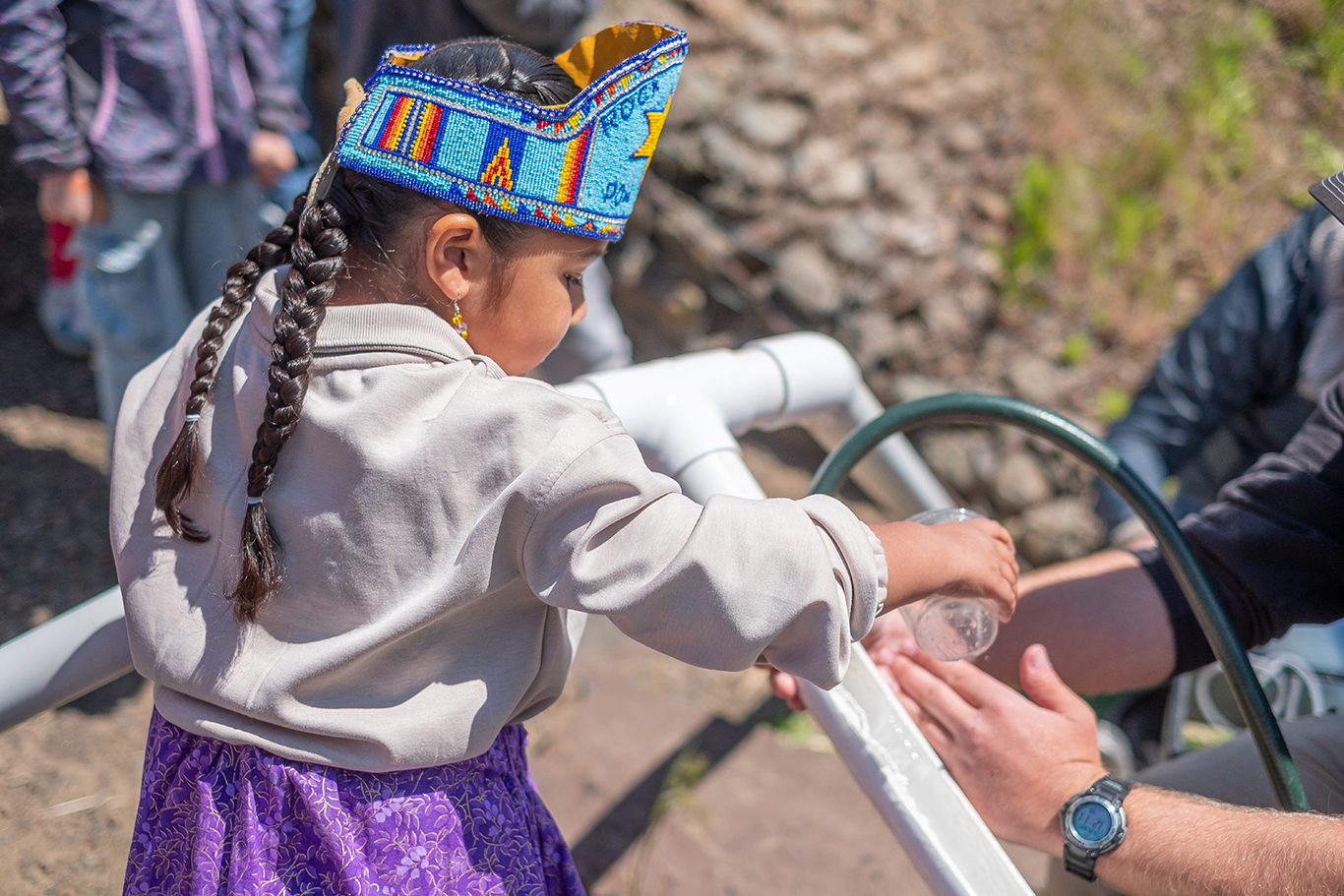
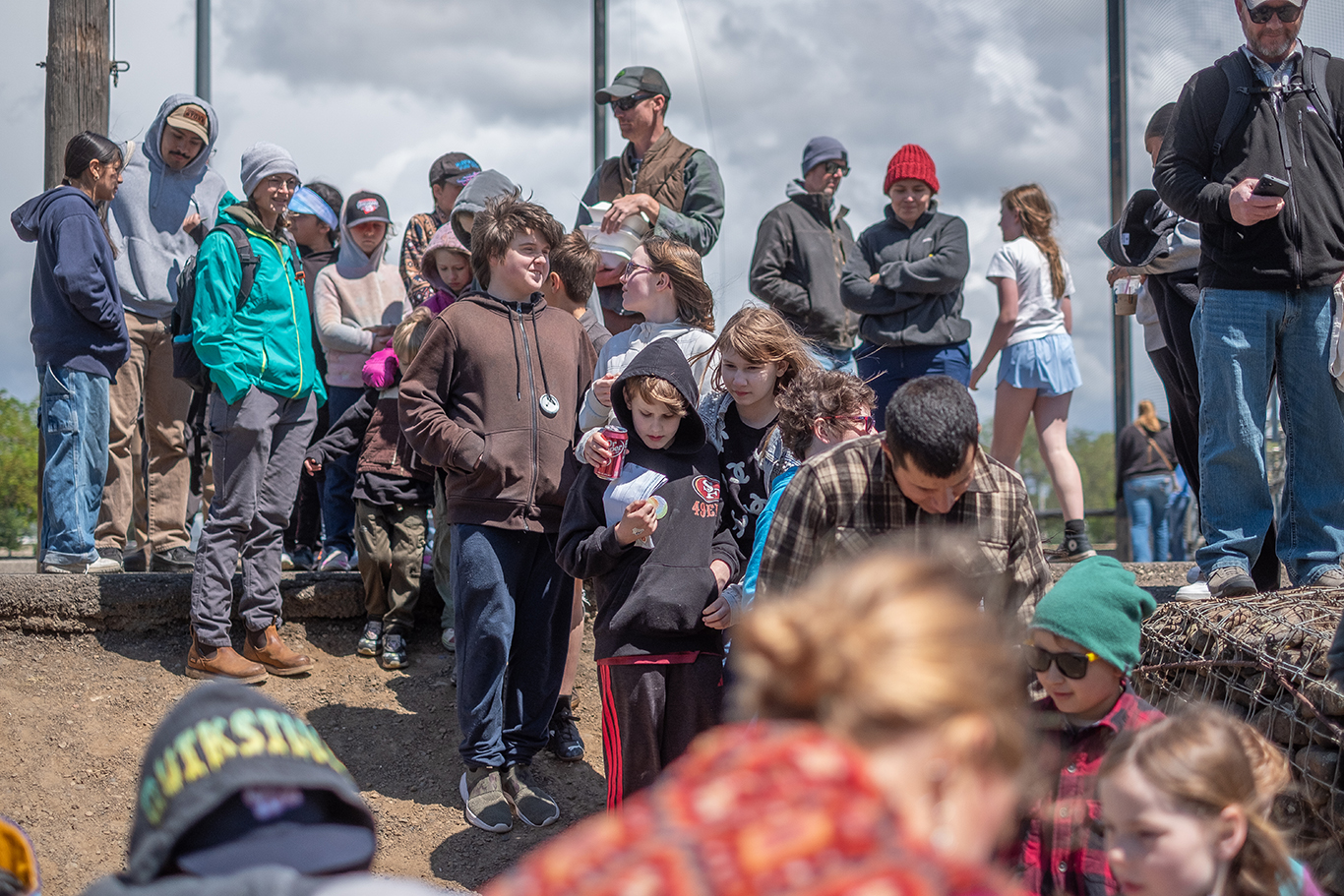
WALLA WALLA — Dozens of children crowded the riverbank, holding cups of tiny salmon as they waited for their turns to release the fish into the water during the annual Return to the River Festival at Walla Walla Community College (WWCC).
The Confederated Tribes of the Umatilla Indian Reservation (CTUIR) and WWCC’s Water and Environmental Center co-hosted the annual festival on May 16 to celebrate salmon restoration and provide a glimpse into the region’s cultural and natural resources history.
Children lined up during two sessions to name and release hundreds of smolts into the river. At noon, they released roughly 160 fish, and at 1 p.m., they released nearly 103 more.
Drew Trogstad-Isaacson, interim director of the Water and Environmental Center, said about 270 juvenile salmon were released into Mill Creek on May 14 as part of the event. He said additional releases earlier in the week through the Salmon in the Classroom program and the Tri-State Steelheaders program included roughly 400 to 500 fish, with fourth-grade students taking part in those releases.
Salmon remain culturally and ecologically significant throughout the Walla Walla River Basin, Trogstad-Isaacson added, where agencies, tribes and community partners are working to restore stable populations that could support future recreational and subsistence fisheries.
Before the first group of smolts was released, Merle Kirk, education and outreach assistant for the CTUIR’s Natural Resources Department (DNR), offered a ceremonial prayer.
Lil’ Miss Rock Creek Powwow Mavis Mata, 4, was the first to release a salmon she named Coco, marking the start of the event’s first session. Mata slowly poured the water from the cup, guiding young Coco down a chute into Mill Creek, returning the young salmon to the river. Afterward, the rest of the children followed.
Wenix Red Elk, DNR public outreach and education specialist, said the tribe launched the festival in 2008 in the Walla Walla Basin to educate the community about salmon restoration and treaty rights.
As the CTUIR advanced water rights and irrigation projects, Red Elk said the tribe also worked with regional partners on water and salmon restoration efforts to bring a broader understanding to the community.
The tribe now operates a fish hatchery near Milton-Freewater and releases more than 500,000 smolt throughout the basin, including in the Walla Walla and Tucannon watersheds, she noted. In addition, the tribe operates a wet lab focused on mussels and lamprey restoration.
During the annual event, DNR staff members manned booths where community members learned about restoration projects and basin-wide partnerships.
More than 30 organizations, institutions and agencies participated, including CTUIR’s Cultural Resources Protection, First Food Policy and Fisheries and Water Resources, as well as the Columbia River Inter-Tribal Fish Commission (CRITFC), the Snake River Salmon Recovery Board and the Tri-State Steelheaders.
“We partner with stakeholders involved in water and natural resource restoration to show the ecological work happening throughout the basin,” Red Elk said.
The outreach also highlights the return of salmon to the river after an absence of more than 80 years, she added.
“When we eventually start harvesting and fishing there again, people will better understand why,” she said. “They’ll know Native Americans are from here, this is where they signed their treaty and this is their home.”
Red Elk said the CTUIR’s work reflects a long-standing relationship with the land and water in the area, emphasizing that tribal presence and stewardship extend “from time immemorial.”
The tribe’s homeland includes not only present-day Pendleton but also its 6.4 million acres of ceded territory, including the Walla Walla River Basin, she said. Restoration efforts are intended to repair those lands and waters for future generations and the broader community that lives there.