MISSION — Months after being ordered to remove illegally dumped waste from tribal trust land, homeowner George Diggins has exceeded his cleanup deadline with little progress, according to Confederated Tribes of the Umatilla Indian Reservation officials.
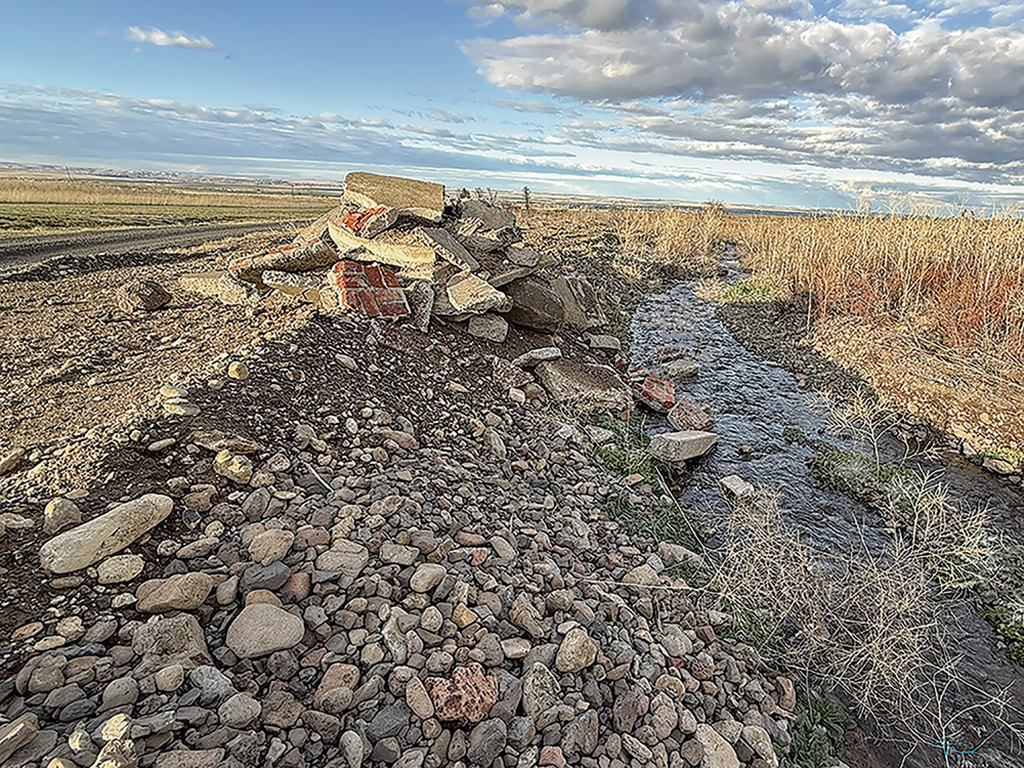
Diggins, 77, was cited Oct. 21, 2025, after officials determined he had transported construction and personal debris from the Wildhorse Resort & Casino construction site across his property and dumped them into Upper South Coyote Creek near the end of South Market Road.
The notice gave Diggins 30 days to remove the debris, but although he received an extension after complying with CTUIR officials, he has since exceeded the deadline.
CTUIR Lead Attorney Joe Pitt said the Office of Legal Counsel has been coordinating with the tribal prosecutor to prepare for the next steps in the enforcement process under applicable CTUIR statutes.
The warning notice cited violations of tribal land development, environmental health and safety, water and historic preservation codes. Brian Fullen, an environmental health and safety specialist for CTUIR, said debris — including asphalt, cinder blocks, bricks, crushed PVC plastic and soil — covered roughly three-quarters of a mile of creek and floodplain.
“This unpermitted land use is in violation of CTUIR law, must stop immediately and requires immediate remedial action,” the notice stated. “If the violation is not corrected within 30 days, or steps toward correction are not being followed, citations will be issued.”
Under federal law, fee land is privately owned and subject to state and local law. In contrast, trust land is held by the federal government for tribal use and governed by tribal and federal regulations.
Diggins has lived on the Umatilla Indian Reservation for 52 years. To confirm property lines, CTUIR officials surveyed the area along an easement road. Diggins lives on fee land east of the stream, while the affected trust land lies to the west. Diggins also has a dump site on his property, but it is unclear why he chose to dispose of the debris along South Coyote Creek instead.
In February 2026, Diggins told The CUJ that he agreed to store the equipment and materials because he owns a dump truck and a pup trailer and had space available. He said that he first planned to place the items on the other side of his property, but changed course after noting that water flows in that direction and a creek had washed out much of the fence line.
“I’m the one who said I got a place for it. It was not their fault,” Diggins said. “We all thought everything was fine. I never dreamed it would develop into this situation.”
Although he did not name any contractor working on the WRC construction site, he said multiple subcontractors are working there, but they were not at fault for his decision to dump the debris on South Coyote Creek.
He said he had begun the process of removing material and consulting with engineers to develop a restoration plan for trust land west of the stream. Diggins said his contractor expected to take two to three days to remove the concrete, followed by clearing the remaining debris. He also noted the work will not take long because much of the material is scattered and vegetation has already grown through it.
He also would provide updates to the CTUIR Planning Department, he added.
“He is working on arrangements to get a qualified engineer involved with a restoration plan for removing the material and restoring the stream,” Patty Perry, Planning director and author of the notice, said. “He must submit that plan to us within a certain period of time.”
During the winter months, CTUIR officials monitored downstream risks during the high-water season. Fullen said the dump debris could undo previous flood mitigation work and potentially affect homes, septic systems and the Umatilla River.
Perry said the creek was prone to rapid flooding, especially near culverts that can become blocked and send water over roads.
Diggins, however, expressed concern that removing all the debris could increase flooding along his road. He said he believed he was protecting his property and preventing flooding.
“Back in my era, people worked to control creeks so they wouldn’t flood nearby land,” he said. “Now it’s supposed to go back to natural.”
He said he did not act with the intent to harm anyone.
Although Diggins is working to clear the debris, Fullen said the dumping has created flood risks and could require a cleanup costing up to $500,000, a cost Diggins would be responsible for covering.
For now, the case remains unresolved as CTUIR officials prepare for the next steps in the enforcement process. Diggins still faces the task of removing the debris and restoring the area, or potentially paying a hefty fine if the work is not completed.