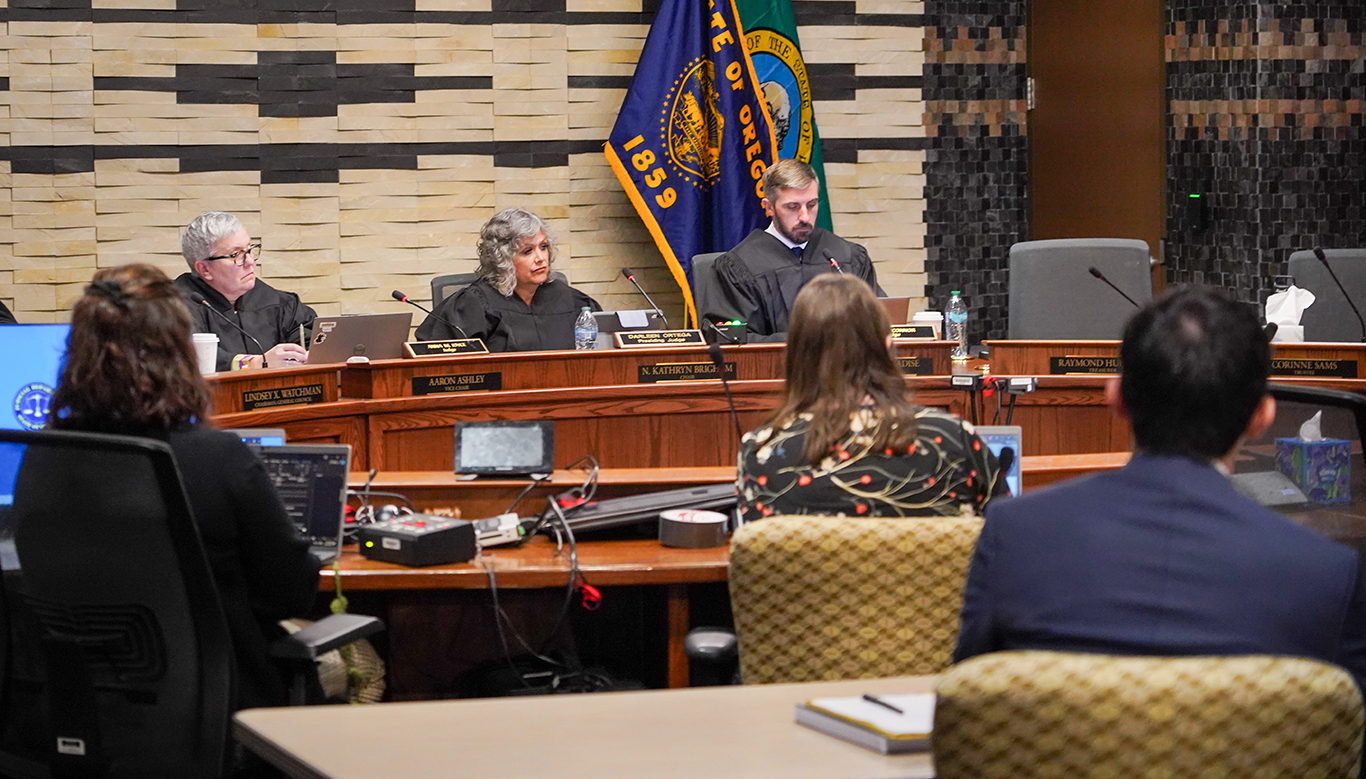
MISSION — The Oregon Court of Appeals made a stop at the Nixyáawii Governance Center (NGC) on Oct. 14 as part of a community outreach program where three justices hear oral arguments in cities across the state.
Community outreach is something the Court of Appeals has been doing since 1998, in which justices work with local schools and courts to schedule trips across the state. The justices had visited Enterprise prior to hearing oral arguments at NGC.
The panel of judges, which consisted of Darleen Ortega, Anna Joyce and Ryan O’Connor, heard oral arguments for three cases at the intermediate appellate level. The three cases included the State of Oregon v. Tik Tok, Inc., the State of Oregon v. Henderson and the State of Oregon v. Dancer.
The State of Oregon v. TikTok Inc. was a case brought up by the state saying the company broke state law by making the app addictive to children, which was prevented by trial court through the First Amendment’s Freedom of Speech protections as well as federal law saying tech companies cannot be held responsible for the content someone else provides through their product.
In the State of Oregon v. Henderson, justices heard arguments for a case based on reasonable suspicion against the defendant, Errol Henderson. According to the case, someone had called the police reporting that a man was swinging an axe while pushing a shopping cart. A few blocks away, police found Henderson, a partial match to the caller’s description, with a wheelchair and no visible weapons. The officer stated he had reasonable suspicion that Henderson was armed and dangerous and called for extra officers who arrived, drew their guns and shouted orders at Henderson, he was then grabbed, handcuffed and searched. A hatchet was found in his pocket.
The third and final case heard at the appellate level was the State of Oregon v. Dancer. The defendant, Daniel Dancer, shot and injured a deer with a shotgun and was convicted of a misdemeanor for harassing wildlife. Dancer was also ordered to give up his gun as required by the state after using a gun to commit a criminal offense.
Students from the senior class at Nixyáawii Community School (NCS) were able to attend the proceedings, ask questions and learn more about Oregon’s justice system.
“It was another opportunity for the kids to witness something they probably never would have,” NCS Principal Ryan Heinrich said.
The court works to choose cases that involve local parties or carry some relevance for their audience, piquing the interest of the students with cases focused around Tik Tok, hunting and reasonable suspicion for law enforcement.
“They took a real interest in the (hunting case),” Heinrich said. “They were high, high interest cases for them to hear and get a taste of what the process is like.”
Confederated Tribes of the Umatilla Indian Reservation (CTUIR) Tribal Court Director Matthew Johnson said this was the first time another jurisdiction had held court at NGC.
“I think it’s pretty historic, really, that we were able to host another jurisdiction to hold hearings in our jurisdiction,” he said. “Hopefully it gets some kids around here interested in the law. I’m just proud of our government’s ability to work with another jurisdiction and make this happen. Being able to host is an honor.”
Heinrich said it was nice for the students to get the chance to ask questions to not only the justices, but also to the counsel. Anywhere from asking for more explanation about a particular case, the process of becoming a judge in the Court of Appeals, or what the appellate process is like.
“It was great to see just how court systems work, like how long ago did (the State of Oregon v. Dancer) start, or how long do they get dragged out?” Heinrich said. “Kids see court cases and think they’re in there for 15 minutes and then the judge slams the gavel down and it’s over. They don’t realize how long it took to get to that point.”